

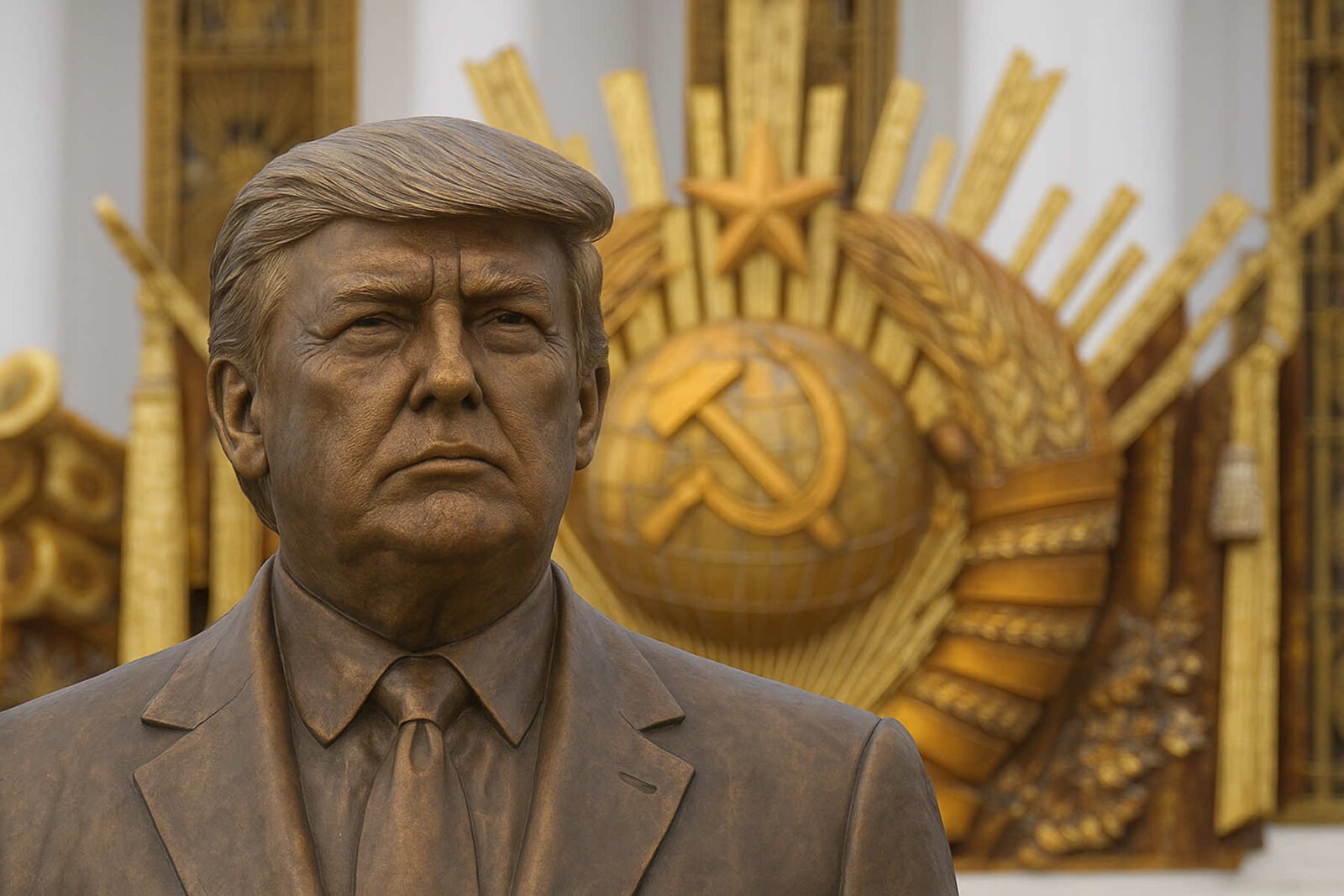
While understandable, the eagerness of Trump and his cronies to resurrect something he himself declared dead—communism—is nonetheless surprising. In recent days, and on more than one occasion, the President of the United States and various spokespeople for the American political system have mentioned the topic. In past writings, I have noted that in each of his speeches at the United Nations General Assembly during his first administration, Trump alluded to the issue, revealing a marked tendency to worry about this “specter haunting America.” Let’s examine this further.
On September 19, 2017, during his speech at the UN, he said: “The problem in Venezuela is not that socialism has been implemented poorly, but that it has been implemented faithfully. From the Soviet Union to Cuba and Venezuela, wherever true socialism or communism has been adopted, it has brought with it anguish, devastation, and failure. Those who preach the principles of these discredited ideologies only contribute to the continued suffering of those who live under these cruel systems.”
A year later, on September 25, 2018, in a speech that seemed to have been written during the Cold War and that ridiculously ignored his own words regarding the freedom and autonomy of each country, he stated that everywhere socialism or communism has produced “suffering, corruption and decadence”.
On September 24, 2019, he focused his “analysis” on China, stating that the Asian power had “refused to adopt promised reforms, but instead has embraced an economic model that relies on massive market barriers, huge state subsidies, currency manipulation, product dumping, forced technology transfers, and large-scale theft of intellectual property and trade secrets.” He added, “One of the most serious challenges facing our countries is the specter of socialism. It is the destroyer of nations and societies.” To “prove” this, he stated that “…in the last century, socialism and communism caused the deaths of 100 million people.” He concluded by reiterating that “the United States will never be a socialist country.”
Despite his obvious ignorance, it’s difficult to understand the reason for such concern. Perhaps it’s because while he garnered 76.9 million votes in the last presidential election, the Chinese Communist Party reached nearly 102 million members.
Or is it because while the population of the United States, Europe, Japan, and Australia—that is, the “free world”—is 1.244 billion, the populations of China, Vietnam, Laos, Cuba, and the Democratic People’s Republic of Korea, which are governed by communist parties, total 1.558 billion, not counting the Indian state of Kerala (36 million)… and the Austrian city of Graz, the country’s second largest, which is also governed by communists?
Perhaps it is because the Communist Party of China (CPC) has just celebrated its 105th anniversary, in which General Secretary Xi Jinping highlighted the “vitality of Marxism as the foundation of the Party’s historical achievements,” reaffirming that: “Socialist China, led by the Party, is recognized as a builder of world peace, a contributor to global development, and a defender of the international order.”
Similarly, the Communist Party of Vietnam celebrated its 96th anniversary in February, recalling that under the leadership of the communists, Vietnam went from being “a backward agricultural economy to a very different one in which GDP per capita increased from just over $100 in 1986 to nearly $5,000 in 2025, propelling the country into the group of upper-middle-income economies and consolidating an economic structure based on industry and services.
The Communist Party of Vietnam (CPV) has reiterated that its leadership “is defined by firmness in its strategic objectives and flexibility in its methods. For the CPV, the unwavering defense of national independence linked to socialism, the adoption of Marxism-Leninism and Ho Chi Minh Thought as ideological foundations, as well as the primacy of the interests of the Fatherland and the people, constitute constant and essential principles.”
Furthermore, on July 1, in a message to Xi Jinping on the occasion of the 105th anniversary of the CPC, the leader of the Democratic People’s Republic of Korea (DPRK) reiterated his determination to further strengthen relations with China and emphasized “the firm and unwavering position of our Party and our Government to continuously strengthen and develop the friendly relations between Korea and China, which have deep historical roots and are based on socialism.” Likewise, the top Korean leader confirmed the firm the will of his country, party and government to “strongly promote socialist construction in both countries and the traditional relations of friendship.”
Even the Wall Street Journal has had to acknowledge that North Korea’s economy has experienced a surprising boom since 2023, registering 3.7% growth in 2024, its fastest pace in eight years. The newspaper has been forced to admit that the expansion of large real estate projects—such as the construction of thousands of homes in Pyongyang—and an increase in the use of electric vehicles imported from China, as well as arms sales to Russia, have helped ease international sanctions against the country and improve its economy.
It is worth noting that, in the midst of the most furious US offensive against Cuba in history, an offensive with clear genocidal intentions, the Communist Party of Cuba (PCC) and the Cuban government approved the largest package of reforms in decades, comprising 176 measures designed to alleviate the country’s severe crisis. Key guidelines include a comprehensive salary reform (with an increase in the minimum wage), decentralization to grant greater autonomy to state-owned enterprises and municipalities, and the expansion of the private sector and foreign capital—all of which is unwelcome to the fascist US government, which seeks regime change and the extermination of the Cuban people. Despite this, the PCC has demonstrated its vitality in the face of the country’s difficult conditions and has solidified its position as the vanguard of Cuban society.
But upon closer examination of the matter and considering the resistance and drive of countries with communist governments, Trump’s warnings about the potential negative impact on his interests worldwide might seem understandable. However, the reality is that Trump’s concern is more about the influence this situation is having on his own country. Only in this way can his furious anti-communist and anti-socialist rhetorical campaign be explained.
In this regard, on June 6, Christian Arrieta, a commentator for the Mexican television network TV Azteca, spoke about the “specter of communism in American politics,” stating that the term has been placed at the center of the debate after Trump posted on his Truth Social network that “communist regimes start with popularity but always end in misery, violence, and destruction,” warning that although the Cold War ended several decades ago, some concepts continue to be used “to shape the conversation and warn that the price of those promises always ends up being freedom.”
Indeed, the last month has witnessed a series of statements from high-ranking representatives of US politics with the clear objective of proposing a new ideological confrontation that leads to a realignment of the world around the United States when its foreign policy is failing in much of the planet.
On June 26, 2026, at a conference in Washington for the Faith and Freedom Coalition, a far-right conservative organization, Trump warned that communism is one of the biggest internal threats, going so far as to say that the victory of candidates aligned with New York Mayor Zohran Mamdani was evidence of a socialist advance that he is determined to stop.
That same day, in a message on his social media, Trump asserted that “the communists are finally making their move” and warned that “the game has begun,” but as is typical of him, he didn’t specify what or whom he was referring to. Trump said he had been waiting a long time “for this” because being a communist “is easy,” it just consists of promising to give “everything” to the people, even if it means “taking it away from others who have earned it.”
He also questioned the historical viability of that political current: “For thousands of years, that ideology hasn’t worked even once,” he stated, before concluding his post with the phrase: “The game has begun. Enjoy watching!” “Thousands of years,” meaning that several millennia before Karl Marx was born, something that didn’t exist didn’t work. What an idiot!
A few days later, on July 1st, in a speech in Medora, North Dakota, he returned to the subject, stating that he would never accept communism. Addressing the attendees, he called upon them to “rediscover the indomitable spirit that built our country and everything that will ensure America remains the most outstanding nation on Earth.” He added, “We will not let the communists stand in our way. We will not let anybody stand in our way.”
With his characteristic ignorance and peculiar interpretation of history, he stated that, “Communism is the greatest threat to our country, including […] World War I, World War II, Pearl Harbor, and 9/11,” asserting that it was a spreading cancer that had to be stopped quickly. Astonishingly, he concluded by saying that he would never allow the United States to become a communist country.
Continuing his diatribe, on July 4th, the 250th anniversary of the Declaration of Independence, at an event at the Mount Rushmore memorial in South Dakota, Trump delivered a speech emphasizing the supremacist character and exceptionalism of his country. Once again, on such a significant date in history, he seized the opportunity to “warn” about the rise of communism, which he considered “a mortal threat to American freedom,” even greater than the First and Second World Wars, when in reality, American territory was never threatened. It is worth remembering that the attack on Pearl Harbor and the terrorist attacks of September 11, 2001, were detected beforehand by the country’s intelligence agencies, but were allowed to occur to justify its entry into the Second World War in the first case and to establish a unipolar world through its “war on terror” in the second. Like any American accustomed to polarizing dichotomies, in closing his speech, Trump stated that one could be loyal to Marx and communism or to the United States and the homeland, but never both.
He asserted that the country was witnessing a resurgence of the “communist threat,” and, like Hitler a century earlier, he clearly identified those he considered enemies of the United States as “immigrants who adopt ideas completely opposed to our way of life and our great success.” His speech concluded with a rallying cry for Americans to “quickly defeat communism.”
But it hasn’t only been Trump who has expressed this surprising unease and disquiet about the supposed advance of communism in the United States. From another perspective, some representatives of the establishment, such as tech magnate Peter Thiel, lashed out at Pope Leo XIV, saying that he promotes Chinese interests by advocating for greater regulation of artificial intelligence. Without mincing words, during the Aspen Ideas Festival in Colorado on July 3, the co-founder of PayPal and Palantir accused the Pope of acting as a “Chinese communist agent.”
In a similar vein, but from the Democratic side, Mike Johnson, Speaker of the U.S. House of Representatives, expressed his fear of a possible communist takeover in the country. However, in this case, it is particularly curious because he is referring to his own party, citing as evidence the victory of his fellow Democrat, Zohran Mamdani, in the New York City mayoral election. Johnson denounced that since his victory, the mayor of the largest city in the United States had dedicated himself to campaigning across the country, speaking in both Democratic and Republican strongholds, proclaiming his policies, and causing “many Mamdanis to appear, running for Congress all over the country.”
He considered it necessary to take seriously what he characterized as a “grave threat “to the entire American governmental system. Without hesitation, he defined them as Marxists and said that what they were doing was “communism, socialism, Marxist deviations that stemmed from a premise opposed to that of the United States.” He therefore called for opposing this trend and combating them not only in electoral terms. In this context, he appealed to Americans to avoid madness and awaken “common sense against communism,” urging citizens to wake up “now that the barbarians are at the gates.”
Thus, it’s clear that it’s not just Trump, the Republicans, or the neoconservative fascists who are behaving this way. It’s much more than that; the entire American political system is under threat. Even Katherine Leavitt, the White House press secretary—who, as is well known, has significant intellectual limitations—used her meager brainpower to claim that the Democrats were “radical Marxists” and that the Democratic Party wasn’t what it used to be. In a hysterical statement, she said that today’s Democrats were communists who espoused “radical Marxist ideas that have never worked in the history of the world.” Does she even know that a country called China exists?
But what is really happening? Why this desperation among the elites in the United States? Next week we will explore some of these questions.
TO BE CONTINUED NEXT WEEK..