


By Prof. Dr. Fernando Esteche
On Friday, July 24, at the Avibras plant in Jacareí, Lula justified Brazil’s rearmament with a phrase that reopened a wound South America thought was healed. He said that “one fine day Paraguay decided to invade Brazil, invaded Corumbá, and at the same time Uruguay and Argentina” (sic). The response from Asunción came quickly. Raúl Latorre spoke of the greatest genocide on our continent. Senator Esperanza Martínez denounced lingering imperialism. Historian and Senator Eduardo Nakayama reminded him, with a date and a specific person, that it was the Brazilian Empire itself that invaded Uruguay before Paraguay had even moved a soldier. Historian Noelia Quintana accused him of omitting the extermination, plunder, and territorial losses her country suffered without any historical justification. In Asunción, no one was surprised by the content of the phrase; what was surprising was that Lula said it and not a retired admiral from the War College.
The phrase lends an epic air to a rearmament that was already underway before Lula even opened his mouth in Jacareí. The 2026 defense budget reached 142 billion reais (US$26.2 billion), 6.3% more than the previous year and the highest level in eight years. It alone exceeds the combined military spending of the other eleven South American countries. Added to this is a six-year, 30 billion reais (US$5.9 billion) naval plan centered on the Álvaro Alberto nuclear submarine. The Army also proposed 456 billion reais (US$89.4 billion) to equip the country with medium-altitude anti-aircraft defenses against drones, a capability that currently does not exist. Lula himself questioned in March why the world spends US$2.7 trillion on weapons while hunger is on the rise, and now he is dusting off a 19th-century enemy to promote 21st-century military spending. The contradiction reveals a government that seeks a national epic, even if it has to trample on the corpse of a neighboring country to find it.
UK the unnamed partner
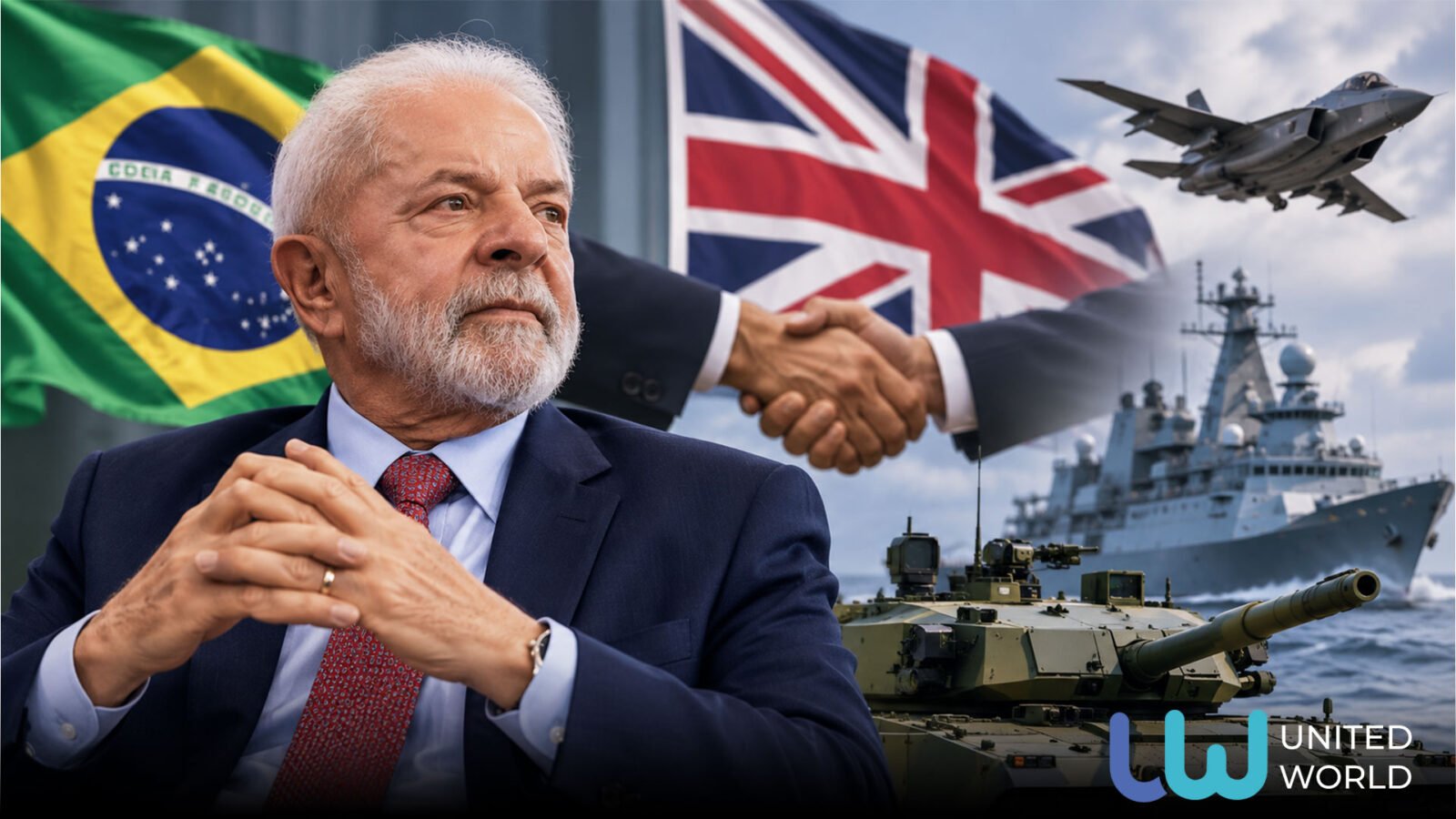
Lula spoke of Paraguay as a threat and said nothing about the partner that finances a large part of this rearmament. On March 26, 2026, on the sidelines of the G7 summit, British Foreign Secretary Yvette Cooper and Brazilian Foreign Minister Mauro Vieira signed the Brazil-United Kingdom Strategic Partnership 2026-2030. The agreement elevates the bilateral relationship to its highest level. On the military front, it expands upon the Defense Capabilities Cooperation Agreement that both countries had signed in 2024. It establishes a political-military dialogue that will bring together the foreign and defense ministries of both countries periodically. It also includes the transfer of military technology, joint armed forces exercises, and cooperation in space and satellites. Brazil also conducts exercises with the United States; Operation Southern Seas 2026 brought the USS Nimitz and the USS Gridley to operate off its coast alongside the submarine Humaitá. The PROSUB program with France is progressing, having already delivered four Scorpène submarines and now developing its own nuclear-powered submarine in conjunction with Naval Group. Brazil is diversifying its suppliers. But the partner that is rising fastest in that hierarchy is once again London.
It’s important to distinguish between the mechanisms, because these Atlanticist partners (not BRICS partners) contribute funds in different ways and in very different proportions. London does so through UK Export. Finance, the state export credit agency, has guaranteed up to £1 billion in defense deals with British companies since 2024. This credit is tied to the purchase of equipment and technology from the United Kingdom, not a direct transfer to the Brazilian budget. France operates with a similar logic in PROSUB; the French state doesn’t contribute its own funds, but guarantees export credit through banks, enabling the construction of the Scorpène submarines and now financing a significant portion of the Álvaro Alberto, with repayment terms spanning several years. The United States, on the other hand, contributes less cash than promises. Its mechanism is the Foreign Military Sales program, the channel through which Washington authorizes and sells military equipment to allied governments. Brazil pays for these purchases with its own funds, and in August 2025, the Brazilian Armed Forces themselves feared being excluded from the program due to deteriorating relations with the White House, until a purchase of Javelin missiles for approximately $31 million was approved in September. The bulk of the rearmament, however, comes from the coffers of the Brazilian State itself and from the credit lines that Banco do Brasil maintains for the national defense industry, with advances and setbacks depending on which government and which bank board is in power.
And no, there is no BRICS-type financing involved in this rearmament. The New Development Bank, headquartered in Shanghai and chaired by Dilma Rousseff, has an explicit mandate for infrastructure, sustainable development, and clean energy. Its own statutes exclude defense and armament projects. Brazil is a member of the bloc and holds the presidency in various forums, but this does not translate into significant military funding through that channel. Anyone looking for a multipolar alternative to Western financing of Brazilian rearmament will not find one there, at least not yet.
This is where what Lula chose to keep silent about in Avibras comes to light. The war he cited as justification for rearmament was, according to Argentine revisionism itself (Argentina being an ally of Brazil in that massacre), a business deal orchestrated with British capital. León Pomer proved this more than fifty years ago in *The Paraguayan War: Big Business*, documenting how the contractors and suppliers of the three allied armies enriched themselves while London banks financed a war they needed to open up the only country in the region that, in 1864, owed them nothing, had its own steel industry, and refused to be subject to the financial arbitrage of the Río de la Plata. José María Rosa reached a similar conclusion from a different perspective. For him, the annihilation of Paraguay was the price paid by the autonomous interior of South America for resisting the City of London. That 160 years later Brazil is once again tightening the military noose with the same metropolis that financed that massacre, precisely when its president evokes that war to justify defense spending, says something that no official statement will ever say. We already pointed this out when analyzing the Donroe Doctrine and the network of agreements that London is forging south of the equator, where we called Brazil the most ambitious partner in that architecture. The calendar itself reinforces this interpretation. The agreement with Cooper was signed four days before Hegseth formalized the new imperial map in Doral.
Milei’s trap of criticizing under fire
The problem is that criticism of Lula cannot be voiced today without encountering another, much dirtier scene. The same weekend that Lula revived the Triple Alliance, Javier Milei took to the stage in São Paulo, alongside Flávio Bolsonaro, and called Lula a thief, a convict, and socialist trash. He also referred to Judge Alexandre de Moraes as bald garbage. Brasília recalled its ambassador from Buenos Aires for consultations and spoke of an unprecedentedly shameful episode. Milei didn’t back down afterward and accused the Brazilian government of financing an anti-Argentine campaign, without providing a single shred of evidence, which he couldn’t possibly have.
Pointing out Lula’s historical error in that exact context requires walking a very fine line. It can be interpreted, or deliberately used by his adversaries, as ammunition for Milei and Bolsonaro’s operation against a regional government. It’s worth stating this plainly. Milei’s insult constitutes electoral interference in the internal politics of a neighboring country and an attack on its institutions, something Brazil has every right to condemn. It’s the fine-tuning of the entire Trumpian logic of subservience, including McCarthyism 2.0. Lula’s distortion is something else entirely; it’s a discussion about historical truth and the risk that a government claiming to be progressive will end up reproducing, to finance its rearmament, the same Mitre-era narrative that the Latin American national left spent a century dismantling. Milei’s interference can be rejected without whitewashing Lula’s narrative about 1864. Lula’s conceptual and moral blunder can be pointed out without conceding an inch to the Argentine right’s attack on Brazilian sovereignty. What must be avoided is that any criticism of a progressive government be interpreted as automatic alignment with the right, or that any defense of Brazil against Milei be interpreted as endorsement of any statement by its president. This confusion benefits both sides equally.
What the official story never told
What Lula said in Jacareí comes directly from 19th-century liberal historiography, which presented the annihilation of South America’s most autonomous economy as a just and defensive war. Paraguay had no external debt in 1864, its own industry, railroads, and telegraph, and a diplomacy that refused British arbitration in the Río de la Plata. Argentine revisionism debated this narrative for decades. José María Rosa situated the war as the culmination of Mitre’s offensive against the federal interior. Atilio García Mellid, in *Proceso a los falsificadores de la historia del Paraguay* (Trial of the Falsifiers of Paraguayan History), reconstructed the propaganda operation that sustained the official narrative. Ortega Peña and Duhalde documented, through the biography of Felipe Varela, the internal resistance to forced conscription. Fermín Chávez traced the continuity between this revisionism and the montoneras (guerrilla bands). It was León Pomer who first called the conflict the War of the Triple Infamy, a term later adopted by Norberto Galasso. Everyone agrees on something Nakayama reiterated these past few days from the Paraguayan Senate, and which almost no one in Brazil repeated. The sequence began with the Brazilian invasion of Uruguay, not with a gratuitous Paraguayan aggression.
On the other side of the border, the Paraguayan revisionist tradition never accepted the narrative of López’s barbarity. Juan O’Leary was one of its founding voices at the beginning of the 20th century. He championed the resistance of a people who lost, according to the most cited estimates, between half and two-thirds of their population and almost all of their adult men, in addition to the territories that today comprise Mato Grosso do Sul, Misiones, and the Chaco. It is worth stating this clearly, because it dismantles any interpretation of anti-Brazilian sentiment. It was a Brazilian, Julio José Chiavenatto, who titled his 1979 research “American Genocide: The War of Paraguay”. One didn’t need to leave Brazil to find the term that Lula should have used in Avibras instead of the one he employed.
The same device, another scale
There’s a common thread running through this scene and another we analyzed a few months ago, regarding the police operation in Alemão and Penha that left more than 130 dead in Rio. There, the enemy was the Comando Vermelho, portrayed as narco-terrorism to justify the DEA’s operations on Brazilian soil. Here, the enemy is Paraguay, transformed into a historical aggressor to justify nuclear submarines and anti-aircraft batteries partly financed with British technology and capital. In both cases, the narrative matters more to those in power than the threat itself. It’s enough that it’s simple enough to be voted on in Congress and old enough not to require explanation.
The question is what Brasília is really trying to achieve with an investment of this magnitude. First, there is a domestic and immediate objective that is rarely mentioned: Lula needs to buy peace with a military establishment that, in January 2023, endorsed, through action or inaction, Bolsonaro’s attempted coup against his own government, and which today, three months before the president confirms whether he will seek reelection, remains a powerful force with veto power. The phased salary increase for the Armed Forces—an additional 4.5% starting in January 2026, impacting 5.3 billion reais (approximately US$1.04 billion) across 740,000 active-duty, retired, and pensioned military personnel—serves as the material counterpart to a governance pact with a military leadership that Lula never fully subordinated to civilian power. Courting the military with a budget and historical narratives, even if those narratives are fabricated, serves a 79-year-old president, with a stalled economy and no majority in Congress, to ensure that those same Armed Forces will not look the other way again if Flávio Bolsonaro loses in October and decides not to recognize the result.
The second objective is geopolitical and does not involve Paraguay or any other South American neighbor as a potential source of conflict. What Brazil seeks to protect is the Blue Amazon, its exclusive economic zone in the South Atlantic, with its deep-water pre-salt oil reserves, its trade routes, and its extended continental shelf. All of this is happening while the Donroe Doctrine is redrawing the hemisphere from Washington, and London is rebuilding its own network of bases and agreements south of the equator.
Brazil’s rearmament reflects the ambition of a middle power seeking a seat at the table, with a permanent seat on the degraded Security Council, leadership in the Global South, and a prominent role in the BRICS and the G20. Brazil prefers to pay the political price for an unfortunate remark about 1864 rather than approach that table unarmed. The objective itself has a degree of legitimacy: a South America capable of defending its own resources. The problem arises when this objective is pursued by strengthening military ties with the very power that historically benefited from this plunder, and by propping up a military establishment whose democratic loyalty remains to be seen.
That’s where it’s best to end, without calling for a textbook regional unity that ultimately says nothing. Milei picked a fight without a shred of evidence, and he got it cheaply. Lula paid with fabricated history for a peace he needed to buy from the same generals who three years ago left him on the brink of losing power. London continues to collect in submarines and satellites what it collected 160 years ago in debt bonds. Calling things what they are, without mixing them up or averaging them, is the only thing that matters to someone who views this from Our America and not from Washington or the City of London.