


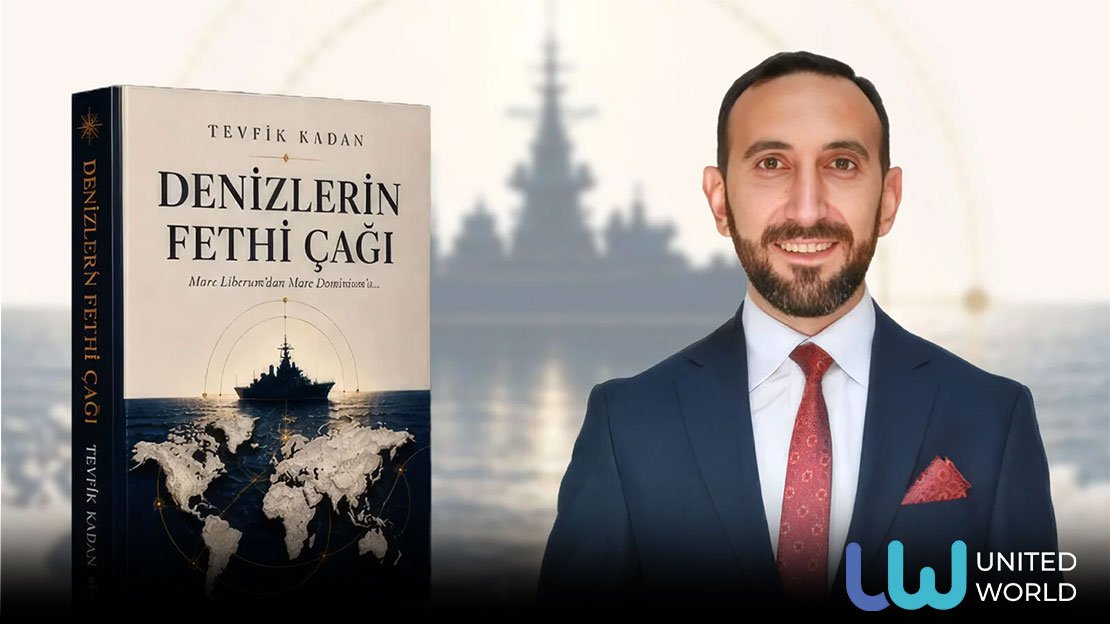
The greatest geopolitical transformation of the twenty-first century is now taking place across the world’s oceans: Tevfik Kadan claims that in his book “Denizlerin Fethi Çağı” (The Age of Conquering the Seas) published by Kaynak Publications in Istanbul in June 2026
Tevfik Kadan, editor-in-chief of the daily newspaper Aydınlık, examines the global struggle for power through the lens of the seas, and argues that, for the first time in history, the seas have become the central arena of this struggle.
According to Kadan, what is now unfolding at sea reflects a confrontation between the Atlantic System and Eurasia.
Being a journalist currently, Kadan also has personal experience of naval education. After passing Türkiye’s military high school entrance examination, he enrolled at Heybeliada Naval High School in 2004. Following four years of study there, he entered the Turkish Naval Academy in 2008. He later left the academy and went on to study electrical and electronics engineering.
We spoke with Kadan about his book.
The opening sentence of your book seems to encapsulate its entire thesis: “History has yet to record the conquest of the seas.” Yet the book is titled The Age of Conquering the Seas. Is this a paradox?
Belongs to all humanity
History brings about its greatest transformations by overturning its most deeply rooted assumptions. For thousands of years, humanity tamed the land: it drained plains and brought rivers under control. Two hundred million people lost their lives in struggles to divide up the land. The seas, by contrast, were unfit for human habitation. They were dark, unpredictable and impossible to bring under sovereign control. That is why law, philosophy and politics converged on the same conclusion: what cannot be conquered belongs to all humanity.
Yet humanity’s struggle with nature continues. Today, we possess a new field of vision stretching from the depths of outer space to the ocean floor. We can see, listen, track and intervene. The sea may still not be humanity’s home, but it has now come within humanity’s reach. That is why I called the book The Age of Conquering the Seas. Sometimes conquest does not mean setting foot on a piece of land, but to be able to alter the destiny of a space.
A threshold
One of the noteworthy claims in your book is that “international law changes along with the balance of power.”
Law does not descend from the heavens. Humanity creates it in accordance with the needs of the world it inhabits. Consider the principle of freedom of the seas. Did that principle truly arise from the conscience of humanity, or from the needs of a handful of major naval powers capable of navigating the oceans? I find the second possibility more convincing.
I believe we are now approaching a similar threshold. States have acquired the capabilities to put their expanding claims to sovereignty into practice.
“Technology changes the meaning of space”
In your book, technology is treated not merely as a technical matter, but as an actor that makes history.
Human history can also be read as a history of range. Stones had a range. Arrows had a range. Artillery had a range. Today, algorithms and satellites have a range.
The reason territorial waters were once set at three nautical miles was not a principle of law, but the distance a cannon could reach. If you can strike a target from a thousand kilometers away today, then you are compelled to reread the old legal texts. Technology does not merely produce weapons, it also changes the very meaning of space.
There is also a powerful debate about civilization running through the book.
The book, appearing to be about the seas, is really about humanity itself. The sea is the greatest metaphor for humanity’s relationship with the unknown.
The way a society looks at the sea is also the way it looks at the future. The fate of nations that remain on the shore will not be the same as that of those looking towards the horizon. Societies that see the sea merely as a place for fishing or holidays will one day find themselves condemned to sailing along routes drawn by others.
“Geopolitical logic” end of hegemonism
One of the major sections of your book is titled “The Collapse of Hegemony.” Are we truly witnessing the end of hegemony?
Hegemonies do not collapse on battlefields, contrary to the belief of many. First they lose their intellectual and ideological confidence, then their productive superiority, and finally their ability to command the seas. That was the story of Rome. It was also the story of the Spanish Empire and Great Britain.
When we speak about the US today, we are not really speaking only about a single country, but the final phase of a five-hundred-year-old Atlantic order. A hegemonic power remains hegemonic only to the extent that it can persuade the world to accept its own law as universal law, its own interests as the common interest and its own security as global security. But when production begins to shift to other regions, technological monopolies are broken and rival centers of power emerge at sea, the persuasive force of that discourse also begins to weaken.
In my book, I argue that American hegemony has reached its limits not only militarily, but also in terms of its geopolitical logic. No hegemonic order in history has lasted forever. The real question is not whether the US is in decline, but what kind of world is emerging to replace it. Our answer to that question is far more important.
Not on maps, but beneath them
Where do you think the greatest geopolitical struggle in the world is taking place today?
Not on maps, but beneath them. In the cables laid across the seabed. In energy pipelines. In ports. In shipyards. In satellite networks.
The route of a container ship can sometimes tell us more than the movement of an armored division. The empires of our age build trade routes first. Armies often follow later.
Eurasia takes to the seas
In your book, you attach particular importance to the “Eurasian axis” formed by Türkiye, Russia, China and Iran. Do you think the convergence among these countries is a current geopolitical choice, or does it amount to something more?
I think it would be inadequate to interpret this process solely through diplomatic relations between states. Throughout history, major geopolitical transformations have begun with a shared perception of threat and later developed into a sense of common destiny. A similar process is now unfolding in Eurasia.
Türkiye, Russia, China and Iran are all heirs to imperial traditions. They know how to build systems. Before seeing them as an alliance, I see them as part of a common civilizational sphere.
For five hundred years, the Atlantic System sought to govern the world from the seas. Eurasia, for the first time, is beginning to think about the seas, the land and production within a single strategic framework. That is why the geopolitical line stretching from Istanbul to Shanghai and from Moscow to Tehran is becoming the backbone not only of transport corridors, but also of a new international system.
Türkiye is not a country at the margins of this picture. IT is the central country linking the Black Sea to the Mediterranean, Europe to Asia, and energy routes to maritime routes.
If Russia represents strategic depth in security, China productive power and Iran geostrategic resilience, then Türkiye represents the key to this vast geography. The issue today is not for one country to establish supremacy over another, but, for the first time in history, Eurasia can construct its own geopolitics in its own conceptual language.
Moving sentence in world politics
What kind of reader did you have in mind when you wrote the final sentence of the book?
A reader can’t find all the answers she is running after in a book. I don’t know all the answers either. On the contrary, I believe there are certain questions we need to debate.
Books do not close down the thought process, but they open it up. If, after finishing this book, a reader no longer looks at the seas, strategic choke points, the Black Sea or the Mediterranean in the same way as before; if they begin to see a tanker not merely as a ship, but as a moving sentence in the language of world politics, then the book has achieved its purpose.