


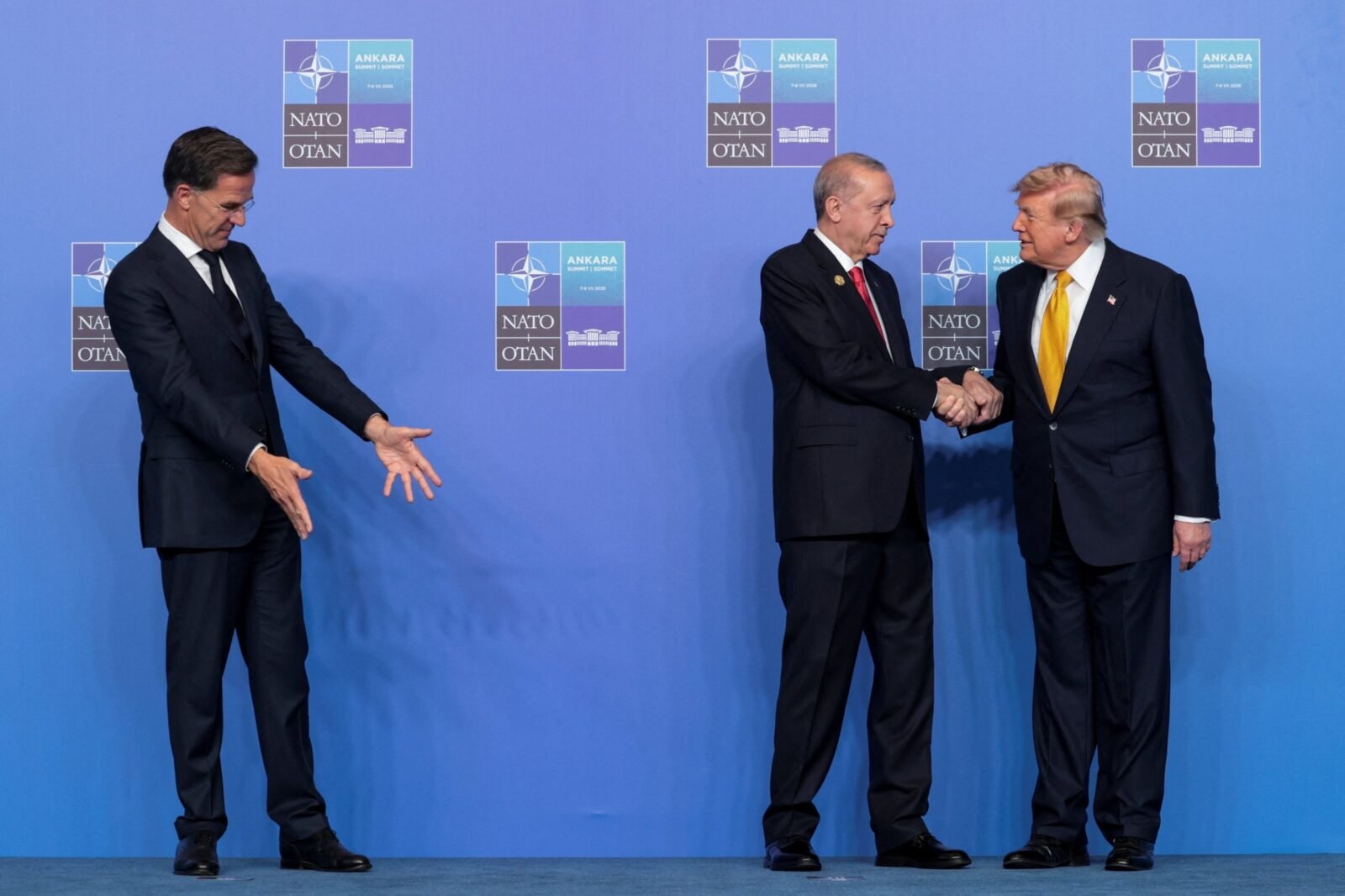
One of the key moments of the July 7–8 NATO Summit was the meeting between Erdoğan and Trump.
CAATSA sanctions, S-400, the F-35, KAAN: intertwined quartet in Türkiye-US military relations
During the meeting, Trump struck a positive tone on lifting the CAATSA sanctions imposed by the US on Türkiye and on Türkiye’s possible return to the F-35 program.
These two issues are directly tied to two other critical defense capabilities for Türkiye: the S-400 air defense system and the KAAN fighter jet.
CAATSA is a sanctions regime that was triggered against Türkiye on December 14, 2020, after Ankara purchased the S-400 system from Russia in July 2019.
Within days of Türkiye’s acquisition of the S-400, the White House and the Pentagon announced in July 2019 that Türkiye had been removed from the F-35 program. Türkiye was expelled from the Joint Strike Fighter program, of which it had been a partner, after paying around $1.7 billion and hoping to acquire 100 F-35 jets. The money it had invested went to waste, and Türkiye received no aircraft.
Türkiye also wants to import engines from the US for KAAN, the country’s first domestically produced fifth-generation multirole fighter jet, developed by Turkish Aerospace Industries (TUSAŞ). Since KAAN uses the US-made F110 engine in its production, the aircraft depends on engines developed by American companies and used in the defense industry. The sale of these engines to other countries requires approval from the US Congress.
Differing views in the country
Therefore, the CAATSA sanctions, the S-400, the F-35 and KAAN form a deeply intertwined quartet in Türkiye-US military relations.
The issue has long been heatedly debated in Türkiye. After the latest Trump-Erdoğan meeting, it once again rose to the top of the country’s agenda.
Is Türkiye striking a “profitable deal” with the US?
Or is Washington offering Türkiye a few minor advantages in order to divert it from its path?
Does Türkiye need the S-400 or not?
Does Türkiye need the F-35 or not?
How important is the lifting of CAATSA sanctions for Türkiye?
What should Türkiye do regarding KAAN?
And what do all these issues mean for the country’s political and geopolitical positioning?
There are differing views.
Türkiye’s reintegration into the US defense system?
Hande Fırat, a journalist close to the government, wrote about the details of the issue in the Hürriyet newspaper on July 9. Fırat said the matter had now reached the point of “whether Türkiye will be reintegrated into the US defense system”:
“Today, there are two separate locks on the Washington-Ankara line: one is the CAATSA sanctions, the other is the sale of F-35s and the process of returning to the program. These two files are linked, but they are not the same thing.
The lifting of CAATSA sanctions does not automatically solve the F-35 issue. However, it would mean that one of the biggest political and legal obstacles before the F-35 process had been overcome. That is why US President Donald Trump’s message during his meeting with President Recep Tayyip Erdoğan like ‘We will lift the sanctions; we will consider the F-35s’ is extremely critical. Because the issue is no longer merely about sanctions; what is now being discussed is whether Türkiye will be reintegrated into the US defense system.”
How could the CAATSA sanctions be lifted?
Fırat also detailed the likely path toward lifting the CAATSA sanctions:
“The legal path for lifting CAATSA is clear: CAATSA gives the US President the authority, on national security grounds, to waive or terminate sanctions under certain conditions. However, the use of this authority is not left entirely to the President’s discretion; it is tied to the conditions set out in the law.
For Türkiye, the roadmap currently being discussed is not based solely on CAATSA provisions. The second pillar of the process is the FY2021 National Defense Authorization Act, which introduced provisions specifically targeting Türkiye.
For this reason, the certification that the President will submit to Congress must comply with both CAATSA provisions and the FY2021 NDAA provisions concerning Türkiye.
Under the provisions introduced specifically for Türkiye, Ankara must no longer possess the S-400 air defense system in its inventory; no S-400 or similar system must be present on Turkish territory; and Türkiye must provide assurances that it will not purchase a similar air defense system from Russia in the future.
Once the President certifies to Congress that these conditions have been met, the process for lifting CAATSA sanctions is completed under the current legal framework, in other words, there is no congressional obstacle.”
“The S-400 systems must no longer be part of Türkiye’s inventory”
As known, the key to CAATSA lies in the S-400 issue. According to Fırat, several formulas previously discussed between the US and Türkiye have failed to produce results. From Washington’s point of view, a solution is possible only if Türkiye removes the S-400 systems from its inventory:
“The real issue is still how the S-400 issue will be resolved. A formula acceptable to Washington has to be found.
So far, options such as storage, removing the trigger mechanism or placing the system under a verifiably inactive status have been discussed. However, according to information obtained, the US side believes that such formulas do not satisfy the current legal framework. From Washington’s perspective, the basic criterion has not changed: The S-400 systems must no longer be part of Türkiye’s inventory.”
Sale of S-400 to a third country
Fırat wrote that the current focus is on the sale of the S-400 system to a third country:
“For some time, diplomatic traffic has been under way through bilateral talks between Ankara, Washington and Moscow. One of the topics is the Russia-Ukraine war, the other is the S-400.
According to information provided by US officials at the latest stage, they believe that the strongest option is a sale to one of the most suitable Gulf countries.
However, the Moscow factor comes into play here. Under the end-user agreement signed with Russia, Russia’s approval is required for the systems to be transferred to a third country. For this reason, Ankara is said to be testing Moscow’s position as well. The Russian side is reportedly not opposed to the idea in principle.”
As for the F-35, Türkiye’s removal from the F-35 program is linked to the CAATSA sanctions that followed the S-400 purchase, but the issue is not limited to CAATSA. The US Congress had also inserted provisions into defense budget laws restricting the delivery of F-35s to Türkiye. For Türkiye to return to the F-35 program, approval is needed from the White House, Congress and the Pentagon. US-Turkish talks on launching this process are continuing.
And finally, there is KAAN.
For KAAN’s engines, US export licenses, company approvals and executive decisions are needed.
According to Hande Fırat, under an agreement worth more than $700 million, 80 engines are expected to be delivered to Türkiye. Each fighter jet will be fitted with two engines. This would allow Türkiye to produce 40 KAAN aircraft in the first phase.
“A new beginning” in the Türkiye-US relations
Fırat wrote that if the US grants export approval for these engines, it will be making not only a technical decision but also a political one:
“Washington would thereby be sending the following message: We can work with Türkiye again in the defense industry. But we are beginning this not with the most sensitive strategic file, such as the F-35, but with more limited areas.”
Fırat concluded her article with optimistic remarks about the future of Türkiye-US relations:
“The lifting of CAATSA will not be the final stage, but a new beginning. The removal of CAATSA sanctions will mean that an important threshold has been crossed between Ankara and Washington, both psychologically and legally. The pressure on the defense industry will ease.”
Hande Fırat’s comments largely reflect the satisfaction within government circles over the recently improving relations with the US.
But, as mentioned above, there are differing views. There are many who argue that the current path with the US is politically and militarily mistaken.
Halil Akıncı, the founding Secretary-General of the Organization of Turkic States and a former ambassador, shared his views on the issue on his X account. Writing in an ironic tone, Akıncı said:
Trump’s “gifts”
“The NATO summit is over. We have heard that the talks with the US were very warm, and that ‘Daddy’ Trump said he would bring gifts such as aircraft engines, F-35s and the lifting of CAATSA sanctions. But since there was not enough room on the plane, he will apparently send them by Senate mail.
I am also witnessing how our European friends, who for many years refused to supply our armed forces with the screws they needed, have suddenly come to their senses and fallen in love with the Turkish defense industry.
I was delighted. But these are merchants. Wouldn’t one wonder: they have given so much, fine, but what did they get in return?
I would be grateful if my seniors enlightened me!
“Loyal ally”
I wrote this before the Summit. There was too much talk of cooperation and too much talk of ‘loyal ally’. Whenever such words are dressed up with compliments, the result is usually a stab in the back.
Defense industry cooperation means: ‘I intend to seize control of your defense industry and your engineers.’
‘Loyal ally’ means: ‘Bark when I tell you to bark, bite when I tell you not to bark.’ When they complimented me by saying, ‘Türkiye is our loyal ally,’ my answer would be: ‘Why do you say that? This adjective is used for dogs. Are we dogs?’ They probably thought my English was weak.”
The KAAN project for breaking free from imperialism
Retired Air Force Pilot Major General Beyazıt Karataş, one of the figures who informed the public during and after the S-400 acquisition process, also commented on the issue on his X account:
“1) The main reason Türkiye was removed from the F-35 project is its purchase from Russia of one system with two S-400 batteries for $1.25 billion, correct? Yes.
2) For this main reason, were CAATSA sanctions imposed on Türkiye by the US? Yes.
3) At this stage, if it happens, is it possible that Türkiye’s procurement of F-35s is not really about the S-400, but rather about postponing the production pace of KAAN after the first 20 aircraft even if the engine problem is solved? Yes.
4) Let us not forget: The KAAN project is Türkiye’s struggle to free itself, ‘even a little’, from imperialism.”
F-35 is technically flawed
Karataş also wrote that the F-35 aircraft are highly problematic from a technical point of view:
“The visual data shared on F-35 statistics come from the June 11, 2026 report of the US Government Accountability Office (GAO). In short, only one out of every four F-35s is capable of carrying out all missions. Those who for years comforted themselves by saying, ‘This is a new aircraft; its problems will surely be fixed in time,’ will not even be able to speak when they read the latest report. I remind this to those who did not believe me when I began explaining these issues around eight years ago.”
“Abandoning the S-400 is a trap”
Another figure sharing his views on the issue was Retired Air Force Staff Colonel İhsan Sefa. Sefa spoke on the issue during a television program.
Sefa said the US’ attempt to make Türkiye abandon the S-400 was a trap:
“The US forced us to buy the S-400. We wanted Patriots, but they did not give them to us. Türkiye then reached an agreement with Russia and purchased S-400. Today, the S-400 is one of the best air defense systems in the world. Neither Patriot nor Siper-2 can intercept a ballistic missile. The S-400 has a greater advantage in this regard. Türkiye needs this system. Why doesn’t the US want this? Because they want to attack Türkiye, and during such an attack they don’t want Türkiye to have the best air defense system.”
Pointing to what he described as Washington’s double standards in defense procurement, Sefa asked: “India also has the S-400. So why is the US still giving F-35s to India?”
Nine bases surrounding Türkiye
Drawing attention to the military base activity around Türkiye and to the final declaration of the NATO Summit, Sefa said:
“If Türkiye sells the S-400s to a third country, it will suffer a major loss of prestige. There are currently nine bases surrounding Türkiye. If the US is Türkiye’s friend, let it shut down these bases. If you are our friend, then end the military exercises conducted by Israel, Greece and the Greek Cypriot Administration of Southern Cyprus against Türkiye.”
Thanks to the CAATSA sanctions…
Like Beyazıt Karataş, Sefa argued that the F-35 fighter jets don’t meet the required technical standards and are beset with problems:
“Nobody is buying the F-35s. It has no credibility. There are disruptions in its procurement and logistics system. It constantly breaks down. The aircraft’s operational availability rate has not exceeded 50 percent. Under NATO standards, this should be 70 percent.”
Lastly, according to Sefa, the CAATSA sanctions had benefited rather than harmed Türkiye. He said “Fortunately, the CAATSA sanctions happened, because thanks to them we achieved major advances in our defense industry.”