


Over the past three years, the war that erupted between Israel and the Palestinian resistance on October 7, 2023, has transformed into a raging regional war across multiple fronts. No sooner do these fronts calm down and subside than they flare up again, entangling various international and regional parties in different ways.
During these years, Israel—backed by the United States—has been a primary party in a war that has, at different times and to varying degrees, drawn in Iran and its proxies in Lebanon, Yemen, and Iraq. As events unfolded year after year, it became obvious to anyone with eyes that this was not just another war like those Tel Aviv fought in past decades merely to chip away at more land and secure itself against its adversaries.
It has become clear that the two main parties to the war, Israel and Iran, were fighting not in defense of a specific right or to ward off a particular threat, but rather as part of an attempt by each to impose its own vision on a reshaping Middle East—a region whose future contours are quietly forming, awaiting whoever can seize its leadership and assert control.
Competing Visions
In reality, neither party emerged empty-handed. Israel succeeded in devastating the Gaza Strip, which posed a serious security threat to it, throwing it centuries back. Consequently, talking about the establishment of a Palestinian state at the present time has become a form of emotional pandering, or rather, pipe dreams. The war also led to the fall of the Assad regime, which ruled Syria for decades, to be replaced by a regime shaped by civil war rebels who possess neither the will nor the capacity to pose any threat to the Hebrew state. Most importantly, the Gulf States—some of which began normalizing relations with Tel Aviv several years ago—have come to view Israel as a counterweight to the threats that trouble them, which they see emanating from Iran and its regional proxies.
On the other hand, Iran—which lost heavily with the fall of its ally Bashar al-Assad in Damascus, and the assassinations of its man in Lebanon, Hezbollah leader Hassan Nasrallah, as well as its Supreme Leader Ali Khamenei—succeeded, through the painful blows it managed to deal to Israel (which led to direct US military involvement), in downsizing much of the mythical image that Tel Aviv had projected of itself to claim regional leadership. Not only that, but the war—in which Iran still stands resilient against the United States—has rattled global markets, particularly oil markets, due to its ability to disrupt navigation in the Strait of Hormuz and shake the stability of Gulf economies.
The battles of the past three years have failed to decisively secure regional leadership for either party, nor have they imposed either’s vision for the New Middle East. However, it is certain that the labor pains currently shaping the region’s future will not yield an outcome that satisfies either or both of them.
For instance, although Israel succeeded over the past years in rallying Gulf states against the concept of resistance in the region, the recent rounds of war against Iran revealed the fragility of the actual geopolitical weight of those nations—weight upon which the Hebrew state was counting to exploit and impose its terms on the regional balance of power.
At the same time, the proxies and resistance movements Iran relied upon to destabilize the region—in order to monopolize the upper hand and the final say in regional calculations and decisions—proved weak in the face of the formidable Israeli-American military machine. Furthermore, even the Strait of Hormuz card, which Iran used to blackmail global powers, has become, once activated, a card that turns the world against it, weakens its position, and renders targeting it internationally acceptable and legitimate.
Although the years-long open war remains unresolved, and despite indications that it will not deliver everything its parties hoped for, it is certain that it has largely overlooked—whether deliberately, intentionally, or out of sheer ignorance—that there are other parties with interests that could be harmed by the imposition of either vision.
These parties will not easily accept the leadership of an alien, small state over the region according to an agenda that disregards the characteristics and interests of the peoples who have inhabited it for thousands of years. At the same time, they will not accept the leadership of a large, ancient state on a sectarian or doctrinal basis in a region encompassing dozens of sects and denominations, nor on the basis of fragile pockets that put everyone’s interests at risk for the sake of ideas that experience has proven to yield catastrophic results.
Egyptian-Turkish Apprehension
Two of these parties are Egypt and Türkiye, two major regional powers that have long maintained different approaches and divergent interests over the past decades, often engaging in overt friction regarding the visions to be pursued across multiple regional files.
Although both countries hold diplomatic ties with Israel, they have sensed over the past years that Tel Aviv, in its protracted war, has violated all legal, humanitarian, and military red lines—to a degree where accepting any of its repercussions or potential outcomes is no longer viable. Consequently, what they used to reject and denounce through mere statements and condemnations is no longer sufficient. Coordination between them began timidly as Israel’s unfettered aggression persisted in the Gaza Strip, before turning overt following its incursion into Syrian territory.
However, since the Israeli war shifted away from Tehran’s proxies to Iran itself, and with the direct American involvement in the conflict, there is no longer any room for assumptions of goodwill. Both nations realized that they and their interests could fall into the line of fire at any moment. Therefore, it was not surprising to see both countries, alongside Saudi Arabia and Pakistan, step into the mediation efforts between Iran and the United States, acting as a counterweight to prevent Washington and Tel Aviv from isolating Tehran.
In my view, the movement of these two countries was not aimed at mediation as much as it was an attempt to provide soft support to Iran. Tehran has suffered staggering losses that could cause its destabilization as a balancing power in the region—a power that prevents Israel from securing major gains exceeding what it failed to achieve through war. This is the very method Israel has traditionally used to influence American decision-makers to bolster its influence in various conflicts, despite its limited gains on the ground.
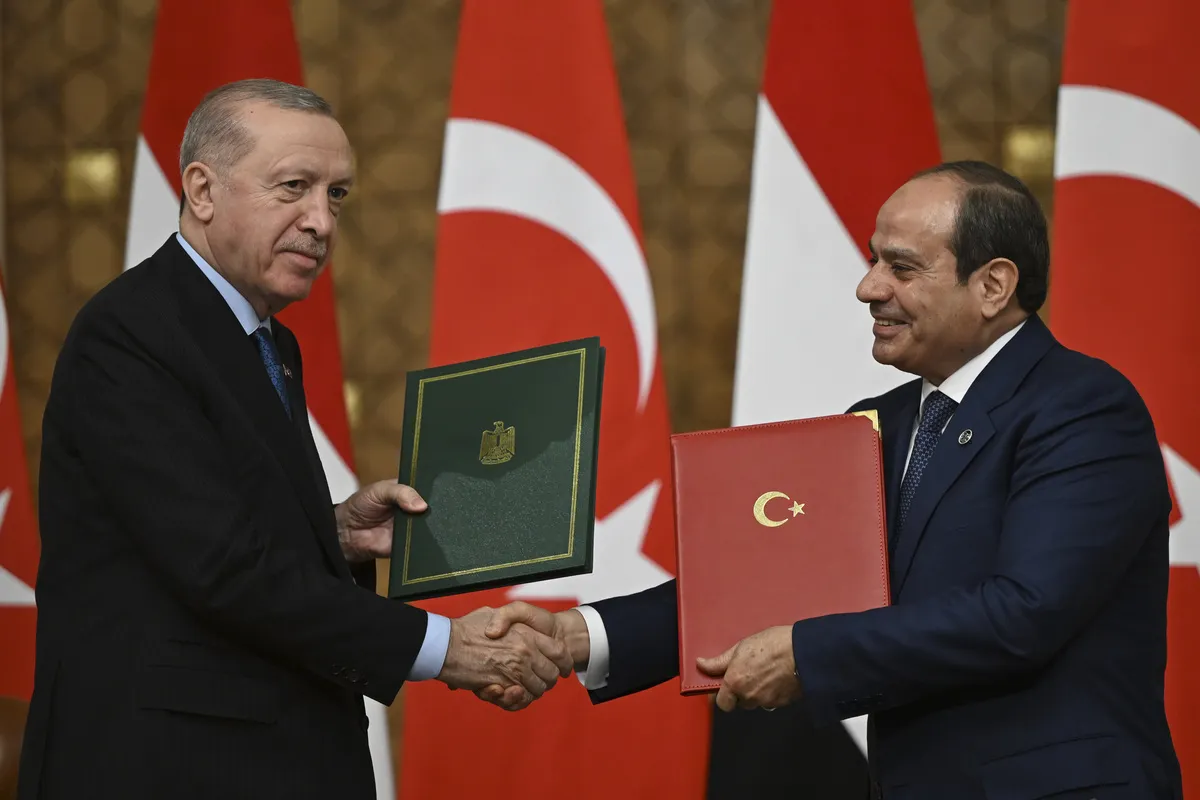
Israel’s declared ambition to reshape the Middle East, coupled with the aggressiveness it has displayed over the past three years to achieve its security and political objectives, deeply disturbs both nations. This has driven them to transcend all past differences, transitioning from rivalry to a quietly forming cooperation and alliance. This alliance is built on the realization that neither country can afford to feign indifference anymore, nor can they assume that current events are not driven by deep-seated motives to radically alter the region at the expense of their own interests.
From hostility to cooperation
Against this backdrop, the visit of Egyptian Defense Minister Ashraf Salem Zaher to Ankara came as his first foreign trip since assuming office, and the first by an Egyptian defense minister since 2013. The distinct nature of this visit caught the attention of observers, prompting them to emphasize the critical weight of the security and military files discussed by officials from both countries, and to affirm that both nations have transcended the stage of rapprochement into a phase of military and security partnership.
According to informed Egyptian sources, recent months have witnessed a remarkable development in coordination between the two sides across several strategic files—an advancement that would not have materialized if not for the pressure of current regional challenges.
These sources indicated that the current movements of both countries go beyond merely developing bilateral relations; they represent a partnership aimed at restoring the strategic and security balance in the region by addressing the imbalances recently caused by Israel’s unfettered regional aggression. One source clearly stressed that the existing consensus between the two nations is a necessity to protect their interests, which have been severely damaged by Israel’s expansionist policies.
Observers echo this view, noting that the contours of this partnership have already been reflected for some time in how both countries handle files of mutual interest, such as stability in Libya and Sudan, as well as the Eastern Mediterranean gas file. From this perspective, former arenas of conflict have transformed into a model for cooperation and dispute management. However, these same observers view the Egyptian Defense Minister’s visit to Türkiye as a powerful leap forward in the trajectory of this partnership, as it transitions from political cooperation and security understandings to joint military manufacturing and the exchange of combat expertise.
In our view, this is indeed the case, particularly in light of immense security challenges and a rising demand for defense industries. The signing of a letter of intent for defense cooperation between them likely serves as an indicator of the growing prospects for this partnership’s future success, clearly consolidating the transition of bilateral relations from a stage of restoring trust to one of practical cooperation.
A worrying convergence
However, in my assessment, the most critical aspect of all is the strategic files discussed by the Egyptian minister in Ankara, extending far beyond the military dimension. According to our sources, the minister discussed several strategic matters, such as securing mutual interests in the Eastern Mediterranean and the Red Sea, combating terrorism, and protecting international shipping lanes—reaffirming that while the visit appeared military on the surface, its essence was profoundly political.
A quick look at the nature of these files and the areas of joint coordination between the two countries over the recent period confirms that a form of alliance is taking shape, in a manner that may disturb several parties.
For instance, any coordination between the two countries regarding their interests in Eastern Mediterranean gas will undoubtedly put an end to many of the insidious schemes led by Israel, in cooperation with Greece and Cyprus, to undermine the interests of many regional countries in this gas resource.
Furthermore, any understandings between Cairo and Ankara regarding the peace council in Gaza will, by necessity, throw a wrench into the gears of Israeli ambitions in the Palestinian territories. This is especially true if this issue is linked to both parties’ desire to protect international trade routes and secure shipping lanes, which have faced escalating threats over the recent period.
Additionally, after years of political divergence between Egypt and Türkiye regarding the Syrian file, Ankara’s involvement in security arrangements within northern Syria is met with growing Egyptian interest in the future of the Syrian state and its role in the Arab regional order. This renders the military dialogue between the two nations even more critical in the coming phase, potentially disrupting all Israeli plans to exploit the Syrian card and chip away at its territory.
The suspicion with which Israel views this rapprochement is entirely logical, particularly since both are military heavyweights in the region, making any confrontation calculations highly complex. This apprehension was expressed by the Israeli newspaper “Maariv”, which noted that US intelligence believes Egypt and Türkiye are quietly working to strengthen broad military cooperation that could include arms deals capable of altering the balance of power.
Despite the subtle innuendo woven between the lines of the Israeli newspaper, an Egyptian source emphasized that the rapprochement between the two countries does not mean the formation of an alliance against Israel. Rather, it primarily aims to defuse regional tensions and enhance regional coordination efforts across various files, especially since Egyptian policy is fundamentally built on diversifying military partnerships.
As for Greece, this discomfort also surfaced in a report by the newspaper “Kathimerini”, which asserted that the accelerating defense rapprochement between Cairo and Ankara does not pose an immediate threat to Greek interests at present, but it does raise further concern in light of the ongoing turmoil within the region’s geopolitical balances.
A pressing question
Yet, a question remains—one that might have been dismissed as pure fantasy had it been asked years ago, but has now become a question of absolute necessity: Could relations between the two countries evolve to the level of concluding a mutual defense pact, or even forming an official military alliance that transcends diplomatic and security coordination and cooperation in manufacturing and armaments?
The Turkish military represents the second-largest military force in NATO and ranks 9th globally according to the “Global Firepower” index, while its Egyptian counterpart ranks 19th on the same index. Given Türkiye’s significant superiority in the production of unmanned aerial vehicles (drones), ammunition, armored vehicles, combat carriers, electronic warfare systems, and radars, any talk of cooperation between these two major powers in joint defense manufacturing signifies to any observer that this step was preceded by others, and will be followed by more on a path toward an alliance that is by no means impossible.
The two countries have engaged in four military exercises, beginning with the “Sea of Friendship” naval maneuvers in September 2025, and most recently last week as part of the “Anatolia Eagle” joint air training, alongside a number of joint military meetings and exchange visits between military officials of both nations. This rapid development in the rapprochement between the two countries coincided with unprecedented tensions between each of them on one side, and Israel on the other.
There has been unprecedented tension in recent years between Cairo and Tel Aviv, fueled by the Gaza Strip crisis, the Israeli army’s seizure of the Salah al-Din (Philadelphi) Corridor, the Israeli right-wing’s criticism of the Egyptian army’s presence in Sinai, and talk of displacing Palestinians into the Egyptian peninsula.
Concurrently, the relationship between Tel Aviv and Ankara is at its worst, to the extent that Israeli Prime Minister Benjamin Netanyahu warned that Türkiye would be the next front for Israeli military targeting following the recent war with Iran. On the other hand, the Israeli and Greek air forces participated in joint maneuvers on the island of Crete last week.
A Quiet Egyptian Repositioning
Therefore, despite the seemingly friendly relations between Egypt and Greece, a quiet repositioning of alliances is taking place in the Eastern Mediterranean. This marks a significant departure from how things stood a decade ago, when the Egyptian side was aligned with Greece and Cyprus while its relations with the ruling regime in Türkiye were strained.
According to an Egyptian source, Cairo has not abandoned its good relations with Greece; however, this by no means implies that such ties substitute for the substantial interests Egypt sees in a rapprochement—or even an alliance—with the Turkish side.
In the source’s view, Türkiye is a major state whose interests and influence overlap with strategic areas and interests that Cairo cannot easily relinquish. Issues such as Syria, Libya, the security of the Red Sea, and the Horn of Africa are all files that necessitate coordination and cooperation with Ankara.
Consequently, and according to the source, the recent multi-front Israeli war has compelled Cairo to seek allies who share its vision for recalibrating the rhythm of regional conflicts, ensuring that no Israeli encroachment is permitted within Egypt’s traditional spheres of influence, whether in the Levant or the Gulf states.
In my assessment, there are genuine Egyptian concerns that the new regime in Syria could turn into a compliant tool for the Gulf states and their miscalculations, which fail to view Israel as a threat to regional security. While the strong bond between Bashar al-Assad’s regime and Iran was disturbing to the Gulf States, this does not mean it should be replaced by a helpless regime that is entirely subservient to Israeli actions, or one that revolves around a Gulf security vision that sees no issue with Israel leading the region.
Given the difficulties facing the development of relations between the Egyptian regime and the new Syrian regime—which still harbors in its structure remnants of terrorist organizations that rose to power with it during the civil war, and still largely depends on Gulf financial support for its survival—Cairo is in great need of an understanding with Ankara. This cooperation aims to manage Damascus’s calculations, amid fears that the new regime might miss the mark by getting entangled in local or regional conflicts that serve Israeli political and expansionist agendas—especially since the new Syrian regime owes a great deal to Türkiye for its rise to power.
Not only that, but Türkiye also represents an important power vis-à-vis the West, which is exerting significant efforts to normalize the Syrian regime’s relations with the world, potentially in exchange for painful concessions regarding the national security of Syria in particular, and the Levant in general.
A Partnership Short of an Alliance
On the other hand, the Turkish side—which harbors legitimate concerns over Israeli expansion into Syrian territory as well as certain Syrian loyalties to Tel Aviv—realizes that a confrontation with Tel Aviv is coming, sooner or later. Therefore, it sees that both itself and the Egyptian regime share a common interest in curbing Israeli influence in the Levant, just as they do in the Eastern Mediterranean region.
Consequently, as its friction with Greece and Cyprus escalates, Ankara is attempting to weaken Egypt’s commitment to its rivals’ alliance. It is capitalizing on Cairo’s strained relations with Tel Aviv over the Gaza Strip crisis, the Rafah crossing, and Sinai, breaking into this space through concrete steps and measures—including the development of Egypt’s armament capabilities, an issue Cairo has prioritized heavily since President El-Sisi took power in 2014.
Despite this, I believe Türkiye may not fully succeed in unraveling the Egyptian-Greek-Cypriot alliance for reasons pertaining to Cairo itself, which frequently struggles to settle on definitive choices, often forcing it into neutrality. This is compounded by the fact that relations between Egypt, Greece, and Cyprus are historic, and that Cairo does not actually possess many leverage cards regarding the emerging gas alliance between Tel Aviv, Athens, and Nicosia.
Therefore, given all these realities, the furthest the relations between the two countries can reach is high-level security coordination, mutually beneficial political understandings, and even a deepening of military cooperation.
As for military cooperation, it possesses unimaginable opportunities for success and prosperity. Egypt does not have a highly advanced military industry, unlike Türkiye, which stands to reap substantial financial profits in this sector.
However, a military alliance in the technical sense is entirely ruled out, because the combat doctrine of the Egyptian army recognizes no enemy but Israel. This simply means that Egypt will not wage any war in general unless absolutely necessary, and such a war would only be against Israel. Consequently, it is highly unlikely that Egypt would enlist Türkiye to threaten Israel, or that creating such a threat would be a primary objective of their relations. Thus, what Egypt is merely attempting to do is show that it is moving, preparing, and developing its capabilities without actually becoming entangled in fueling what could lead to war.
These facts by no means diminish the level that Egyptian-Turkish relations have achieved. In truth, what has been accomplished and what is currently underway represents a genuine breakthrough and profound political maturity reached by both nations to safeguard their interests and prevent the region and its destiny from falling into a single hand that controls its peoples and resources. This is far better than their past disputes, which allowed Israel and Iran to manipulate the course of events until all dangers broke free from their restraints, threatening the survival of states and regimes to realize either power’s vision of a New Middle East they dominate, with no regard for international law or the rights of its citizens.