


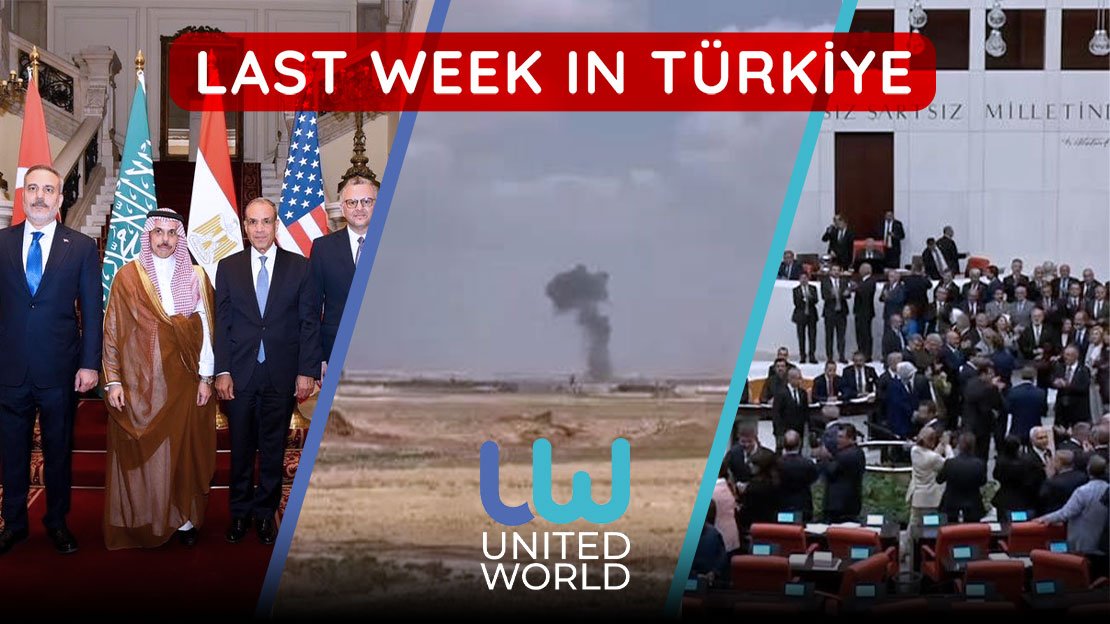
Despite the August heat, Türkiye had a busy agenda last week.
Foreign Minister Hakan Fidan visited Libya and Egypt.
Israel’s attacks on Syria were another widely discussed topic.
And the debate over the “framework law” related to the disarmament of the PKK terrorist organization continued.
Foreign Minister visits Libya and Egypt
Foreign Minister Hakan Fidan paid important visits to Libya and Egypt between August 11 and 14.
Fidan first held talks with different sides in Libya on August 11–12, before traveling on to Egypt for high-level meetings on August 13–14.
In Libya, Fidan held talks in both Tripoli and Benghazi, in other words, in the country’s west and east, with the two sides that have laid claim to governing the country since Muammar Gaddafi was ousted from power in 2011.
Fidan met officials from the Tripoli-based Government of National Unity, which Türkiye has supported for many years, and then held talks with the forces led by Khalifa Haftar, who controls eastern Libya. In Tripoli, Fidan met with the prime minister of the Government of National Unity Prime Abdulhamid Dbeibah and other senior officials. In Benghazi, he held talks with General Haftar, House of Representatives Speaker Aguila Saleh, and other officials.
Following this extensive round of meetings, Fidan stressed that the contacts had been conducted within the framework of Türkiye’s “One Libya” policy:
“As Türkiye, we do not see Libya’s peace and stability as separate from our own stability. In line with the vision set out by our President, we will continue to support stronger dialogue and cooperation between western and eastern Libya and contribute to Libya’s peace, stability and prosperity.”
Fidan also highlighted Türkiye’s priorities in Libya. These included securing recognition by any new political structure of the security and maritime jurisdiction agreements signed in 2019, preserving Türkiye’s place in a future security architecture should Libya’s security institutions be unified, and expanding Türkiye’s economic role in the country’s reconstruction, particularly in energy, infrastructure and contracting.
Following his meetings in Libya, Fidan traveled to Egypt.
During his visit, Fidan attended the Second Meeting of the Türkiye-Egypt Joint Planning Group in El Alamein.
The meeting addressed a number of important issues, particularly bilateral trade and logistics, and resulted in agreements in several areas.
Fidan also held talks with senior Egyptian officials, including President Abdel Fattah el-Sisi and Foreign Minister Badr Abdelatty
The timing of the visit drew particular attention, coming amid developments surrounding the signing of the Mecca Mutual Defense Agreement between Türkiye, Saudi Arabia and Pakistan, and discussions over Egypt potentially joining it.
Following the visit, Fidan mentioned an “excellent level of relations”:
“Our visit to Egypt provided an extremely important opportunity to discuss our bilateral cooperation, which is progressing at an excellent level, as well as developments in our region.”
During the Joint Planning Group meeting and Fidan’s other talks, the two sides discussed cooperation across a number of fields, including industry, energy, and logistics, and particularly the goal of raising bilateral trade volume to $15 billion.
The current situation in the Eastern Mediterranean, military relations and cooperation in the defense industry were also on the agenda.
Regional issues likewise featured prominently in Fidan’s meetings, including the Gaza Peace Plan, the continuing political crisis in Libya.
On Gaza, it was emphasized that coordination between Türkiye and Egypt is continuing, while in Libya, the two countries were stated to be developing a common approach centered on preserving the country’s territorial integrity.
Regarding the Mecca Agreement, Fidan had previously said, “I believe Egypt will also be among us”.
Reactions to Israel’s attack on Syria
Last week, Israel struck the Abu al-Duhur Military Airbase in Syria’s Idlib province, close to the Turkish border.
In a statement, the Syrian Foreign Ministry described the Israeli strikes as an “unjustified attack” and a “dangerous escalation” threatening the security and stability of the region.
On August 19, telling an army radio podcast, Netanyahu said that Israel had initially sent a message “in general terms” against a Turkish military presence at an airfield near Aleppo. “Apparently they didn’t hear it, so we made sure they understood it more clearly,” he said, and added, “We will not tolerate a Turkish military entrenchment moving southward, because it threatens us”.
On August 20, Israeli Defense Minister Israel Katz said that Turkish President Recep Tayyip Erdoğan is “dragging Türkiye into dangerous adventures in Syria” and “Israel will not allow any entity to threaten its security.”
Türkiye’s Ministry of National Defense stated that Turkish troops were not present at the base during the strike and strongly condemned Israel’s aggressive policies, and added:
“Israel’s attack on Abu al-Duhur Airbase is an act aimed at damaging Syria’s stability and security, the unity and integrity of the country, as well as its infrastructure.
We reiterate at every opportunity that attacks violating Syria’s sovereignty and territorial integrity are unacceptable.
We state that no Turkish military delegation was present at the base either before or during Israel’s attack on Abu al-Duhur Airbase in Syria.
For the peace and stability of both Syria and the region, it is essential that Israel put an end to such reckless attacks and fulfill its obligations under international law.
We will continue to support Syria’s efforts to build its infrastructure and military capacity within the framework of the principle of ‘one army.’”
The Foreign Ministry also issued a statement:
“We strongly condemn the air strikes carried out by Israel in the early hours of today [August 18] against the Abu al-Duhur Military Airbase in the countryside of Syria’s Idlib province. Israel recklessly continues its attacks targeting Syria’s infrastructure and capabilities and violating its territorial integrity and unity.
We call on the international community to adopt a more resolute stance in order to bring an end to Israel’s aggression against Syria, which is taking on a new dimension with each passing day, and to ensure accountability for these actions carried out in blatant disregard of international law.”
As tensions between Türkiye and Israel continued to rise over Syria, US Ambassador to Ankara Tom Barrack in an interview with the Jerusalem Post commented that the strike “carried a real risk of rapid escalation into a direct military confrontation between Israel and Türkiye as well as Syria.” He said, “Turkish forces were not aware that the Israeli aircraft were en route to that specific Syrian base, nor of their intended purpose, and therefore could potentially have been inclined to scramble their own jets in the belief that they themselves were under attack.” Barrack added, “The events of yesterday were serious and worrisome. However, we are relieved that no human life was harmed and that the situation did not escalate.”
He also stressed the need for a deconfliction mechanism between Türkiye and Israel and said work is underway on the issue.
Debate over the “framework law” continues
The “framework law,” which sets out the legal basis for the process called “Terror-Free Türkiye” and provides the basic framework for the dissolution of the PKK terrorist organization, suspension of prosecutions and sentences in cases linked to the PKK/KCK terrorist organization, had been passed by Parliament on August.
Following the law’s publication in the Official Gazette, Nationalist Movement Party (MHP) Chairman Devlet Bahçeli, a party in the governing coalition, made a series of statements about both the legislation and the broader process.
Speaking to Türkgün, MHP’s own newspaper, Bahçeli offered the following assessment:
“Although the first stage of a ‘Terror-Free Türkiye’ is to have the terrorist organization lay down its arms and clear the region of terrorist elements, its objectives also include enabling Türkiye to act more independently in foreign policy, strengthening peace and stability in its immediate neighborhood, and increasing its influence across a broad geography stretching from the Eastern Mediterranean to the Caucasus and from the Middle East to Europe.
In essence, it is clear that an attempt is being made to stage the second act of the ‘Eastern Question’ in our region. The objective is fragmented and divided sovereign states. Türkiye, however, has disrupted the new Sykes-Picot order and the sinister schemes embodied in Balfour through its goal of a ‘Terror-Free Türkiye,’ while the emergence of a terror-free region has dealt a blow to imperialism’s ambitions.
The division into sub-state ethnic, religious, and sectarian groups with manageable autonomous regions, together with illegal and terrorist organizations waging proxy wars in these areas, has long posed a threat to Türkiye’s ontological security. Political instability in countries such as Lebanon, Iraq and Syria, and fragmented and manipulable structures in our region, affect not only Türkiye’s border security but also its sovereignty and its social and institutional fabric.”
Bahçeli placed the issue within the broader international balance of power:
“Instability in our region has entered a new chaotic phase with the US/Israel-Iran war. This dirty war has deeply affected the peace of the peoples of the region, the global economy, and our country, both economically and in humanitarian terms. The wars continuing across the Islamic world have deeply saddened our nation, which is part of the Islamic Ummah, the Ummah of Muhammad. Israel’s massacre in Gaza and the Zionist attacks against Al-Aqsa Mosque, our first qibla, are unacceptable to us. On the other hand, Syria has freed itself from the long-standing oppressive Baath regime and is on the path toward becoming a stable country. In these circumstances, Türkiye, through its rational policies and diplomatic efforts advocating peace, has become a country that is trusted, respected and whose friendship is sought.
For this reason, the success of the ‘Terror-Free Türkiye’ process and Türkiye’s foreign-policy concept reinforce and directly affect one another. While our national unity and solidarity and our sovereign rights are strengthened on the domestic front, Türkiye must continue to pursue a determined, multidimensional, proactive, and peaceful foreign policy in line with its national interests.”
President Recep Tayyip Erdoğan also issued a statement on social media regarding the law after entering into force. Erdoğan said:
“I hope that the Law on Strengthening National Solidarity and Social Integration, which was adopted and entered into force with the support of 467 members of our Grand National Assembly as a historic example of consensus, will bring beneficial results.”
He continued:
“For this important step taken toward Türkiye’s peaceful, prosperous and secure future, I sincerely thank our People’s Alliance partner Mr. Devlet Bahçeli and the Nationalist Movement Party Group, Speaker of the Grand National Assembly of Türkiye Mr. Numan Kurtulmuş, my valued companions in the AK Party Group, and all political party groups and members of parliament who, despite standing on different political grounds, adopted a constructive approach.
I congratulate the institutions and officials of our state who have contributed to bringing the process to this stage. Taking into account the sensitivities of our entire nation, particularly the families of our martyrs and our veterans, we will continue to manage this process with the same sincerity and care, on the basis established by the Law and under the leadership of our relevant institutions and bodies.”
Meanwhile, some opposition parties continued to voice objections to the Framework Law.
The Good Party organized rallies against the law, first in the capital city Ankara and then in the city of Balıkesir.
Speaking at the rally in Balıkesir, Good Party Chairman Müsavat Dervişoğlu sharply criticized the governement:
“There is something plainly before us. I am talking about a system that has taken all of Türkiye and all of politics hostage like a seven-armed monster: its economy, markets, productive sectors, the media, academia, the judiciary, foundations, associations, chambers, trade unions, political parties, and, of course, every organ of the state. The center of that system is the Presidential Palace. They want to leave no room to breathe in any sphere.”
Dervişoğlu continued:
“Apparently, the Turkish nation is expected to remain silent about the wishes coming from İmralı (where PKK leader Öcalan is imprisoned), the government’s open bargaining with Kandil (the headquarters of the terrorist organization). Apparently, we are supposed to watch as 9,000 terrorists and drug traffickers arriving from prisons, terrorist camps and from Europe and walk around freely. (…) We are supposed to keep silent to this law that allows them to achieve through politics what they failed to achieve through arms in 50 years.
Dervişoğlu also described the new law as “an amnesty law for terrorists.”