

By Prof. Richard Sakwa, Political Scientist
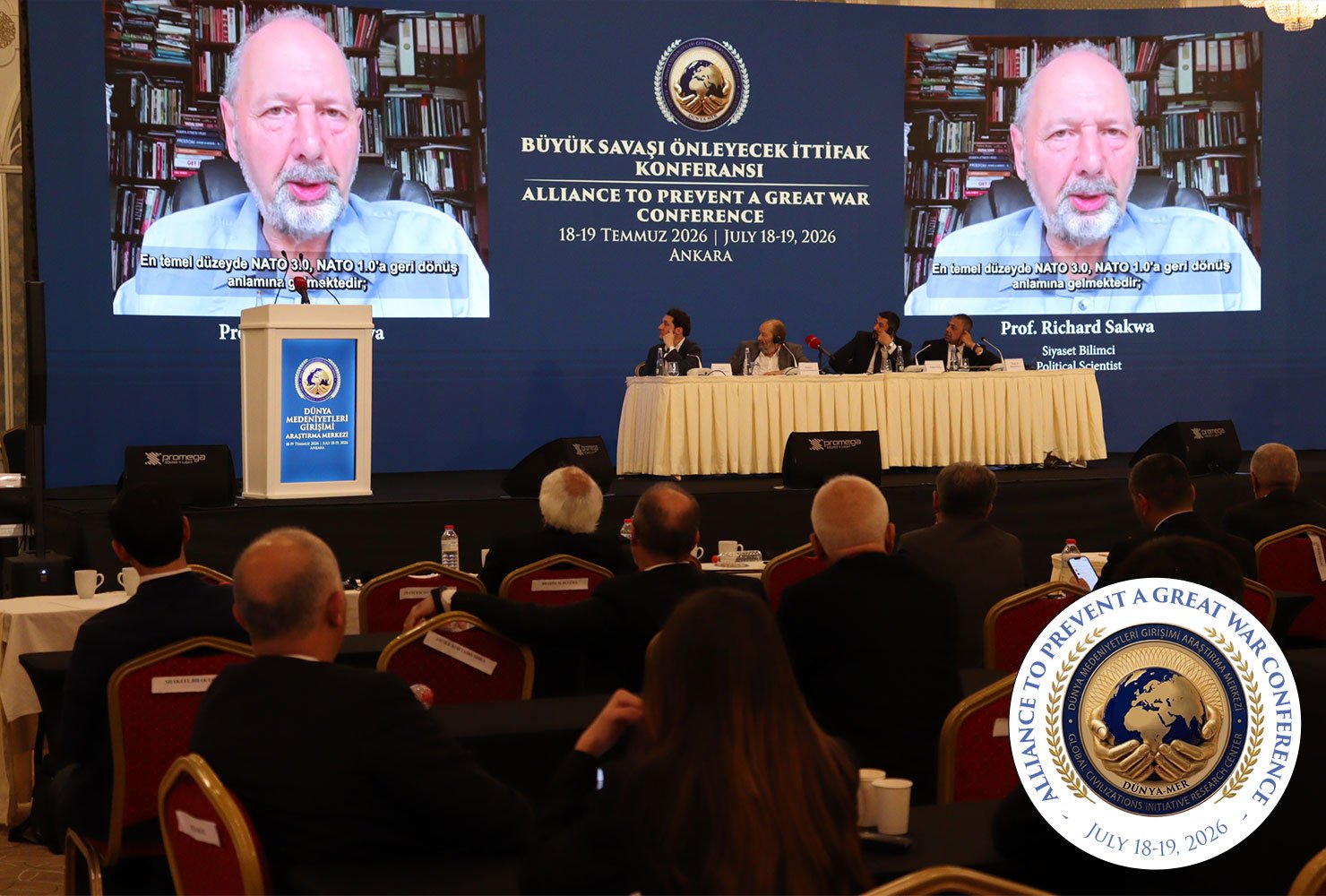
The international conference entitled “The Alliance to Prevent a Great War,” organized by the World Civilizations Initiative Research Center, was held at the Meyra Palace Hotel in Ankara on 18–19 July 2026.
UWI will present the speeches held on the conference during the coming days.
The conference, which featured presentations by speakers from Azerbaijan, Belarus, France, Germany, Greece, Iran, Italy, Japan, Russia, the Sahrawi Arab Democratic Republic, South Africa, Spain, Switzerland, the Turkish Republic of Northern Cyprus (TRNC), Türkiye, the United Kingdom, and the United States, was attended by approximately 200 distinguished invited guests.
Ministers, members of parliament, ambassadors, retired generals, scholars, politicians, diplomats, military officers, and experts examined the question of the “Alliance to Prevent a Great War” from a wide range of perspectives.
Below, we present the speech of Prof. Richard Sakwa. The title was set by UWI.
I’m Professor Richard Sakwa. It’s a great pleasure to be with you today, virtually, if not in person. Clearly, NATO is facing a very uncertain future. I think that the latest Ankara summit reflected some of that uncertainty.
NATO is now entering a new phase, what he calls a NATO 3.0. So what does this mean?
Clearly, NATO 1.0 was a child of the Cold War. It obviously established in 1949 to fight the Cold War to fight communism.
And then, of course, at the end of the Cold War, 1989 to 1991, not only did the Cold War end, of course, but the Soviet Union itself disintegrated. And this then makes us enter into NATO 2.0.
The third NATO, the one that we now live with, or the one that is now being planned, is a fundamentally new beast. On the one side, NATO 3.0, as Elbridge Colby would say, it has to evolve. In order to allow the United States to deal with larger issues, not just European security, above all in the South China Sea, Taiwan, and other issues far away from the European homeland.
That takes me to my second point. And that is clearly NATO’s transformation in a multipolar world. The world has changed. This NATO 3.0 has to operate in a very different context. But the summit, the NATO summit in Ankara, confirmed and accelerated the transition to this third style. At the most basic level, NATO 3.0 is a return to NATO 1.0. That is to confront and contain Russia as the continuous state of the Soviet Union.
And what does this mean? What did we get at Ankara? That the alliance has entered into a new phase. Greater European responsibility. More defense industrial capacity.
And more than that, an expanded strategic agenda.
My third point, just briefly, is to say that clearly what it ultimately clearly failed to do is to deal in any serious, sustained way with the Ukrainian war, which is, after all, being waged on our European continent. And that is clearly a strategic failure of enormous proportions.
The idea was that we could bomb Russia into negotiations. That was the bottom line. And clearly that is not a strategy that is likely to work. But it is liable to escalate the conflict.
And so, Ankara failed to deal with the danger of horizontal and vertical escalation of the continent. Horizontally, that is, to extend the war to the European mainland.
And, of course, vertical escalation would mean the use of perhaps a tactical nuclear weapon within Ukraine or something like that.
That may be a success in the short term, but if it was pacified on the framework of escalating the Russo-Ukrainian war into a full-scale Russo-European war, well, that once again shows, just like NATO 2.0, that the very existence of NATO becomes a threat to the very existence of Europe because we are on the verge of an escalation, possibly, into the final apocalyptic.
And this takes me to my fourth and final point. And it’s one much talked about. For example, the former Turkish foreign minister and later prime minister, Ahmet Davutoğlu.
He argues that the greatest challenge to NATO today comes not from adversaries, but from within. That is undermining the pillars on which the Atlantic alliance system was created. We’re seeing tariffs, the undermining of free trade. We’re seeing the undermining and rejection of international law, the primacy of the Charter international system, and so on.
Again, on that same thing, and my final point on this fourth issue, that is that we’re witnessing a normative erosion of NATO. As well as strategic incoherence. What is NATO for today? And Jeffrey Sachs, as always, has something to say on this issue. He’s warning that NATO is drifting towards strategic failure and nuclear risk, which goes back to my earlier point, that NATO lacks a strategic vision. And there was no such vision at the Ankara summit.
Unfortunately, bloc survival has now taken the place of establishing strategic direction.
So NATO faces an uncertain future. And even though Ankara may well have done many other things, of course, re-established the centrality of Türkiye to NATO. And of course, there’s a powerful military force on the flank towards into West Asia. Its strategic position is even more important than ever before. But as I say, NATO really needs to have a fundamental debate. Its mere survival, its mere existence is not sufficient rationale for its continued existence. It needs to find a purpose. I’m sure one could be found only if it is within the framework of Charter internationalism and devised to enhance the cause of peace. And development on the European continent not to intensify war. So I’ll stop on that point. Thank you.