


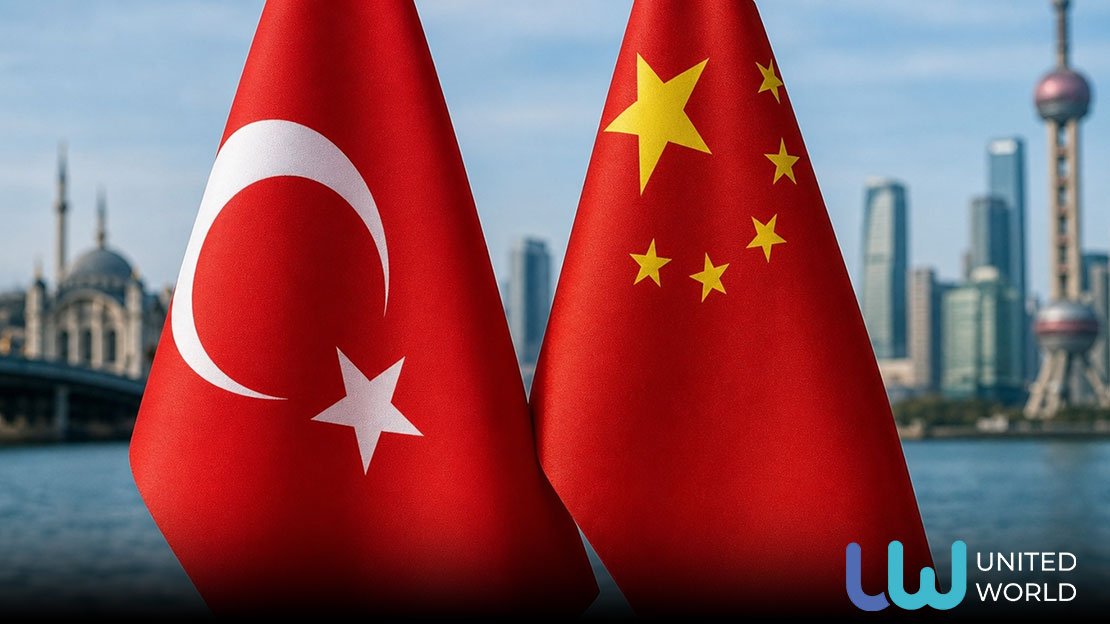
By Orçun Göktürk, from Beijing / China
In July 1971, following US Secretary of State Kissinger’s Beijing visit that shocked the world amid the Cold War atmosphere, the US and its allies established diplomatic relations with Beijing one after another. Ankara also received the message and initiated official relations with Beijing less than a month after Kissinger’s visit, despite having a war against the People’s Republic of China (PRC) in Korea.
Although Turkish-Chinese relations reach their 55th anniversary this month, economic and political ties between the two countries did not gain momentum until the 1990s. Interestingly, while Turks owe their historical existence over thousands of years mostly to Chinese written sources and interacted with the Chinese many times during their journey from Far Asia to Anatolia, Ankara waited for a signal from the West to recognize the CPC-led, Beijing-based PRC.
Structural Problems Despite Growing Trade Volume
Starting in the 1990s, the fruits of China’s 1978 opening-up reforms and its steady two-digit growth figures placed the country at the center of the global economy, which directly reflected in its commercial relations with Türkiye. Bilateral trade volume, which stood at around 1 billion dollars in 2000, reached 28 billion dollars in 2016 and is expected to cross the 60-billion-dollar mark this year, making China one of Türkiye’s largest import partners.
The most prominent structural problem in bilateral relations is the chronic trade imbalance against Türkiye. Since China joined the World Trade Organization in 2001, Turkish companies have faced fierce competition in global markets. While Türkiye’s exports to China remain stuck in the 3–4-billion-dollar range, imports exceeding 50 billion dollars exert severe pressure on the current account deficit. Turkish officials follow a strategy focused on attracting direct Chinese investments and tourist inflows to counterbalance this asymmetry.
However, we observe that the public debate in Türkiye addresses this issue solely by blaming the Chinese side. Yet, even the world’s largest economy, the US, runs an average annual trade deficit of nearly 300 billion dollars with China. The problem, from one perspective and most importantly, should be sought in Ankara’s lack of a national economic construction strategy based on production and detached from the Atlantic economy.
Another issue is Türkiye standing out as perhaps the only country in the Muslim world to take a stance against China on the Uyghur issue by following the US lead. In particular, events such as then-Prime Minister Tayyip Erdoğan labeling the 2009 Urumqi incidents as “virtually a genocide,” and Ankara issuing a formal condemnation in 2019 regarding rumors that the famous Uyghur artist Abdurehim Heyit died in Chinese camps—which later turned out to be false—without conducting any diplomatic verification process, politically impede the progress of relations. Nevertheless, Ankara no longer takes as hawkish a pro-US stance as before, while China continues to view the issue strictly through the lens of “non-interference in internal affairs” and “counter-terrorism.”
The AKP’s Balance Card Against the West: China
Since the 2000s, the pragmatic foreign policy pursued by the AKP government has positioned China as a strategic balancing element in relations with the West. The Dialogue Partnership established with the Shanghai Cooperation Organization (SCO) and the “Asia Anew” initiative are concrete manifestations of this approach. Although Turkish officials raise slogans like “Let’s add a ‘T’ to BRICS” or “The SCO is an important alternative for us against the EU” during every crisis with the US and Western countries, no practical progress has been made. In the eyes of Beijing, Türkiye is a balancer that uses the “China card” in foreign policy, but ultimately remains a pro-Western country. Türkiye joined China’s massive infrastructure initiative, the Belt and Road Initiative, in 2015 and merged its own “Middle Corridor” project with it; however, the expected Chinese investments have failed to arrive in Türkiye.
What Should Be Done?
China is perhaps the most pragmatic country in the world regarding foreign policy, especially in economic relations. Even countries like Japan and South Korea, which hold special roles in the US strategy to contain China in the Asia-Pacific, have Beijing as their largest trading partner. Despite this, Türkiye’s growing trade deficit with China—while certainly containing political dimensions—must primarily be evaluated within the dynamics of Türkiye’s own economy.
There is undoubtedly a massive asymmetry in Turkish-Chinese relations. Although Ankara introduced visa-free travel for tourists coming from China this year, Beijing does not grant individual tourist visas to Turkish citizens, let alone visa-free travel. For bilateral relations to develop, Ankara needs a serious, consistent China strategy worthy of Turkish diplomatic tradition. As long as Türkiye remains inconsistent, calls such as Devlet Bahçeli’s proposal for a “Turkic, Chinese, and Russian alliance” will not be perceived any differently in Beijing than previous rhetoric. Ankara must stop hosting Uyghur separatists who operate within the CIA-guided World Uyghur Congress based in Türkiye, and likewise demand that Beijing take the same stance against institutions and individuals affiliated with the PKK and FETÖ in China.
As for the trade deficit, Türkiye currently lacks the economic structure to compete with China in its present state. Instead, Türkiye needs to leverage China’s expertise in areas such as high-technology products and transfer, digital transformation, renewable energy, battery technologies, e-commerce, and even military equipment, while pursuing a strategy that completely excludes the US dollar in bilateral trade. Otherwise, Turkish-Chinese relations will continue to remain well below their potential.