


By Yıldıran Acar, Political Scientist
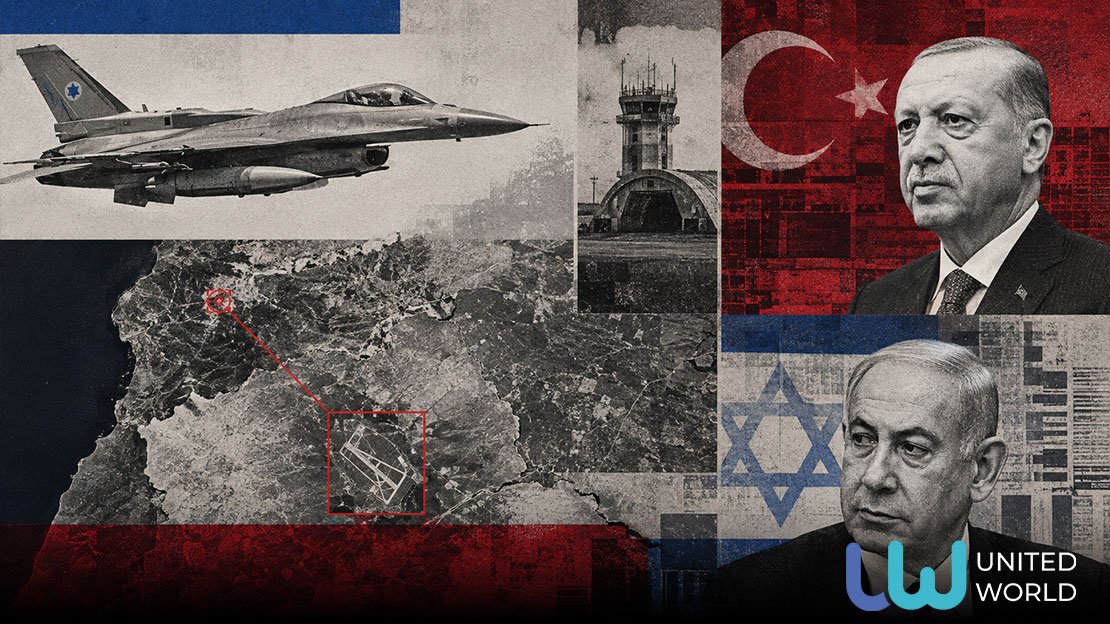
Israel’s attack on 18 August on the Abu al-Duhur airbase in Syria’s Idlib province was a significant development not only in terms of the security balance in Syria but also for Türkiye-Israel relations.
The targeting of the airbase, situated approximately 70 kilometers from the Turkish border, signals a significant shift in Israel’s military approach towards northern Syria. Tel Aviv justified the attack by claiming that Türkiye was preparing to deploy military personnel and weapons systems to the facility in question. Ankara and Damascus, however, rejected this claim.
However, the real significance of the dispute lies not so much in Abu al-Duhur itself as in the competition between Türkiye and Israel that has emerged during Syria’s reconstruction process.
Why did Israel strike Abu al-Duhur?
Abu al-Duhur has been one of the key military installations throughout the Syrian civil war. The facility, which had not been used as an active airbase for some time, came back into the spotlight during the process of rebuilding Syria’s military infrastructure following the overthrow of Bashar al-Assad’s regime at the end of 2024.
Russian military expert Yuri Lyamin, in his assessment for Izvestiya, notes that the attack is particularly noteworthy from a geographical perspective. According to Lyamin, while the Israeli Air Force has so far primarily targeted areas in southern Syria, the center of the country, and the vicinity of the capital, this operation—which extended as far as Idlib—was carried out in a region falling directly within Ankara’s sphere of interest. The expert states that, from Israel’s perspective, the re-establishment of the Syrian air force and air defense is viewed as a security issue in its own right.
Israel’s statements also align with this assessment. Tel Aviv argues that Syria’s provision of military deployment facilities to Türkiye could undermine previously agreed security arrangements. While Israeli Prime Minister Binyamin Netanyahu described the attack as a ‘signal’ directed at Damascus, the Israeli government regards the expansion of Türkiye’s military presence in Syria as unacceptable from the perspective of its own security.
Ankara, however, stated that no Turkish military personnel were present in Abu al-Duhur at the time of the attack and characterized Israel’s operation as a threat to Syria’s stability and territorial integrity.
Türkiye’s role in Syria is expanding
Immediately following the attack, it was noted that Türkiye’s relations with Syria continued to progress in various areas.
Vladimir Avatkov, Head of the Department of the Near East and the Former Soviet East at the Institute of Oriental Studies of the Russian Academy of Sciences and a professor at Moscow State Linguistic University, highlighted in his assessment for ‘’Izvestiya’’ the visit to Damascus by Türkiye’s Minister of Energy and Natural Resources, Alparslan Bayraktar, following the attack.
According to Avatkov, Ankara’s influence in Syria is not limited solely to the security sector. Cooperation developed in sectors such as energy, electricity, mining and transport constitutes another dimension of Türkiye’s long-term presence in the country.
From this perspective, the Abu al-Duhur debate is not merely about the future of a single airbase.
The question of which actors will play a key role in Syria’s reconstruction is also gaining increasing importance.
Ankara and Tel Aviv have differing approaches to security
Türkiye supports the re-establishment of state and security institutions under the new Syrian administration. The military cooperation agreement signed between Ankara and Damascus in August 2025 is also a key element of this policy. Under the agreement, Türkiye is expected to provide support for the restructuring of the Syrian army, personnel training, and the development of military infrastructure.
Israel, however, takes a different view of the emergence of new military capabilities in Syria. In particular, the reactivation of air defense systems, radars, unmanned aerial vehicles, and fighter jets are among the sensitive issues from Tel Aviv’s perspective.
Elena Panina, Director of the RUSSTRAT Institute, also assesses Israel’s operations in Syria in relation to Türkiye’s military maneuver space. Panina notes that the reduction in the US military presence in Syria has opened up a wider maneuver space for Ankara, and that this has necessitated new security calculations from Israel’s perspective.
Consequently, while the rebuilding of Syria’s military capacity is viewed by Ankara as part of the state’s reconstruction, it is assessed by Tel Aviv as a development that could pose a security threat.
A new problem for Washington
The US stance following the attack also drew attention.
Tom Barrack, the US special representative for Syria and Iraq and ambassador to Türkiye, stated that Israel’s operation posed a risk of direct military conflict with Türkiye. According to Barrack, the fact that the Turkish side had not been informed in advance about the targets of the Israeli aircraft could have led to the incident escalating into a more serious military confrontation. The US diplomat described the attack as an “unnecessary escalation.”
Israel, however, maintains that both the US and Syria were informed prior to the attack. Defense Minister Israel Katz stated that intelligence had been shared with the relevant authorities in Washington and that Damascus had also been given advance warning.
The situation that has emerged shows that Washington has been forced to manage the Syria-related tensions between its two close allies. Indeed, the US side has indicated that communication mechanisms to prevent direct conflict between Türkiye and Israel need to be strengthened.
Russian experts say the likelihood of direct conflict is limited
Whilst the possibility of direct conflict with Türkiye is being discussed in the wake of the Israeli attack, Russian experts’ assessments are more cautious.
Yuri Lyamin notes that the attack served as a strong message to both Ankara and Damascus, but that the parties are expected to avoid direct conflict. In his view, the tension is likely to continue primarily through limited military incidents and diplomatic initiatives.
Russian Middle East security expert Kirill Semenov also believes that expectations of a direct Türkiye-Israel conflict are premature. Semenov points out that Abu al-Duhur belongs to Syria both legally and de facto, and that there were no Turkish soldiers in the area at the time of the attack, emphasizing that the incident should not be regarded as a direct attack on Türkiye. In his view, Israel’s primary objective is to limit the process of rebuilding the Syrian air force.
These assessments provide a common framework suggesting that while the tension caused by the attack is serious, it is not expected to escalate into a direct Türkiye-Israel war in the short term.
Ankara’s options
Following the attack, Türkiye’s approach is taking shape not so much around a direct military response as around strengthening Damascus’s security capabilities.
According to a report by Kommersant, Ankara has offered the Syrian transitional administration a new agreement envisaging the strengthening of security mechanisms against Israeli attacks. Options such as early warning and aerial surveillance operations, as well as measures to counter the activities of Israeli unmanned aerial vehicles, have been put forward.
This development suggests that Ankara could shape its security role in Syria not so much through its own direct military presence, but rather by developing the capacity of the Damascus administration.
However, there is an important detail here: as Russian experts have also pointed out, there were no Turkish military personnel present in Abu al-Duhur at the time of the attack. Consequently, the current development is being assessed not as a stage where Türkiye has entered into direct military conflict with Israel, but rather as a convergence of the two countries’ security spheres of interest in Syria.
A new sensitivity in Türkiye-Israel relations
Following the Gaza war, which severely strained Türkiye-Israel relations, the Syrian dossier has now become a separate security issue in its own right.
Ankara’s efforts to develop defense cooperation with the new Syrian administration, while Tel Aviv seeks to prevent the emergence of a new military capability targeting it in Syria, are causing the two countries to operate in the same theater with differing priorities.
The Abu al-Duhur attack is significant for this reason. This is because, while Israel’s operational theater extends as far as northern Syria—where Türkiye has direct security and political interests—Ankara’s cooperation with Damascus is not limited to mere political support.
However, the current situation does not point to a direct conflict. The prevailing view, as highlighted in assessments by Russian experts, is that the parties are testing their boundaries whilst simultaneously seeking to maintain control mechanisms.
The key determining factor in the coming period will be the extent to which Türkiye becomes involved in Syria’s security architecture and the extent to which Israel intervenes in this process.
From this perspective, the Abu al-Duhur attack has revealed that the new balance of power in Syria has not yet stabilized and that the rivalry between Ankara and Tel Aviv will, to a large extent, be shaped by the future security architecture of that country.