


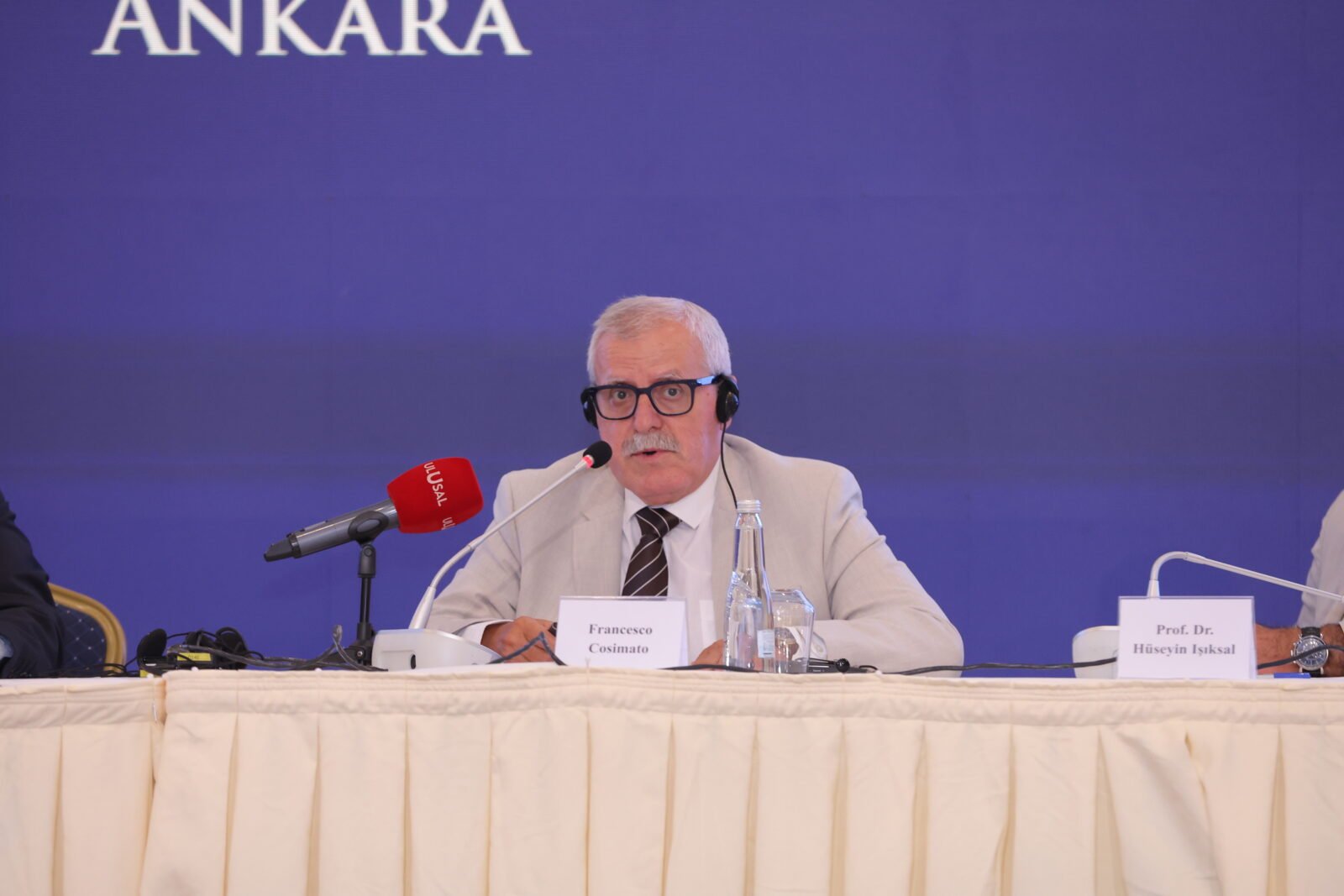
By Francesco Cosimato
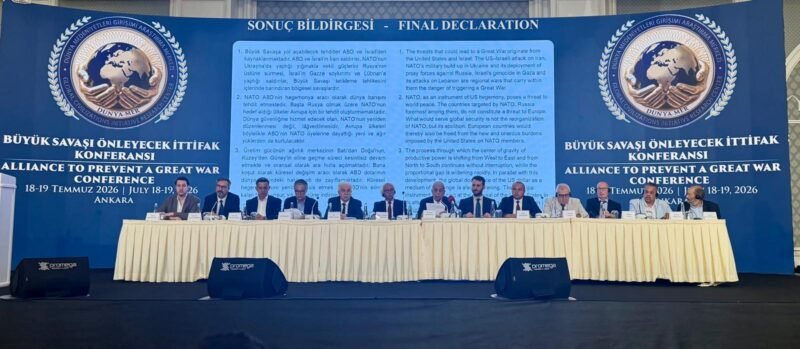
The international conference entitled “The Alliance to Prevent a Great War,” organized by the World Civilizations Initiative Research Center, was held at the Meyra Palace Hotel in Ankara on 18–19 July 2026.
UWI will present the speeches held on the conference during the coming days.
The conference, which featured presentations by speakers from Azerbaijan, Belarus, France, Germany, Greece, Iran, Italy, Japan, Russia, the Sahrawi Arab Democratic Republic, South Africa, Spain, Switzerland, the Turkish Republic of Northern Cyprus (TRNC), Türkiye, the United Kingdom, and the United States, was attended by approximately 200 distinguished invited guests.
Ministers, members of parliament, ambassadors, retired generals, scholars, politicians, diplomats, military officers, and experts examined the question of the “Alliance to Prevent a Great War” from a wide range of perspectives.
Below, we present the speech of Francesco Cosimato. Cosimato is Retired Army Brigadier General of the Italian Armed Forces. The title was set by UWI.
Let me begin with a forecast, a premise, regarding the situation of the United States within the context of all these discussions in Western countries, particularly in Western Europe. I am a general, and my life has always revolved around facts and figures. My entire career has developed along these lines, and I want to examine an idea together with you: Can Europe truly defend itself against threats?
Briefly, we will not delve into the social environment. We will talk about the relationship between war and Europe. Following that, we will touch upon the political stance of Western European countries, a potential Russian attack, strategic assets, and operational forces.
When we talk about the social environment, it is clearly evident that there is a high standard of living being maintained in Europe. This makes it difficult to recruit people into the military. High living conditions make joining wars even harder. Here, we also see immense competition, especially with the private sector, presenting significant challenges.
Western countries face difficulties finding personnel who meet the strict academic, physical, and psychological requirements necessary for service. In this regard, there is a genuine weakness, and retaining personnel is an even greater issue. For instance, throughout my entire career, I moved my family from one place to another, having them relocate with me. This is frankly a problem, and we can also speak of an inadequate housing infrastructure. So, this is the current environment we are talking about. When we look at mainstream European media, these are the primary topics discussed when we mention war in Europe. While some might find these issues somewhat surreal, this is the reality.
We mentioned political stance. There are high-level discussions and talks about war in Western European countries, and citizens naturally do not hold the same views as their leaders; they oppose it. However, political leaders—particularly in Poland and Germany—expect an attack. A Russian attack is anticipated, and a narrative exists around this. I am not passing judgment right now, nor am I attempting to frame the situation in a specific way. This is merely an assessment. We can start from such a premise and perhaps proceed through logical methods; we are simply discussing it.
At the same time, growing protests frequently confront us regarding military aid to Ukraine. In fact, our Prime Minister has also faced criticism over this issue. There is an even larger problem regarding international relations. Just as the discussion surrounding Ukraine’s entry into NATO is debated, its entry into the European Union must also be discussed. This is because the treaty contains a clause stating that if a country comes under attack, it must be defended by other European nations.
We can proceed by asking: Why might Russia attack? Frankly, there is no apparent strategic reason for them to do so right now. Reasons could vary—it could be Russia protecting its energy interests in Europe or minority populations in Europe. However, I personally do not see much of a reason for the Russians to go ahead and attack Western European countries. This is frankly one of those statements repeated daily in Western mainstream media. Naturally, according to open sources, a hypothetical attack is deemed unlikely. Yet, these ongoing processes could trigger a nuclear issue.
Particularly, if we look at what is required to conduct a military operation, you need strategic assets, don’t you? At the most basic level, we are talking about strategic transport, communication, satellites, and intelligence satellites. Therefore, what we are referring to is a process that requires extensive research, time, development, production, and massive financial support.
Currently, some countries are trying to develop partial strategic transport capabilities, and there are certain satellite systems available—specifically satellite systems specialized in communications. These could be adapted for wartime use. However, Europe needs its own independent systems. As everyone knows, there is currently civilian usage of satellites in Ukraine. This gives us an idea: European countries can be considered quite weak in this regard.
Finally, we can talk about operational forces. Defense ministers of European countries consistently complain about a shortage of forces and the weakness of military capabilities. If you look at the Global Firepower network, you can compare coalitions, obtain various charts and data, and calculate whether a military operation can be conducted.
I have created a group here called the “so-called coalition of the willing”—Russia, Belarus… It is also possible to see that while Europeans lead in certain areas, Russia and Belarus appear much further ahead in others, such as tanks. Therefore, war is a very complex phenomenon. It is not merely about the output of weapon systems; it encompasses weapon systems, human power, training, drills, military doctrines, and political will.
I have repeated this story at various events and in different venues whenever a comparison is made between Ukraine and Russia, or between Western countries and Russia. My view is that there are clear and obvious flaws in this comparison.
My conclusion is this: We need to look at whether we are talking about a potential military operation from a specific perspective. Afterwards, I would be pleased to answer any questions you may have.